
2026 Toyota 4Runner vs. 4Runner Hybrid: Limited and Limited i-FORCE MAX Compared
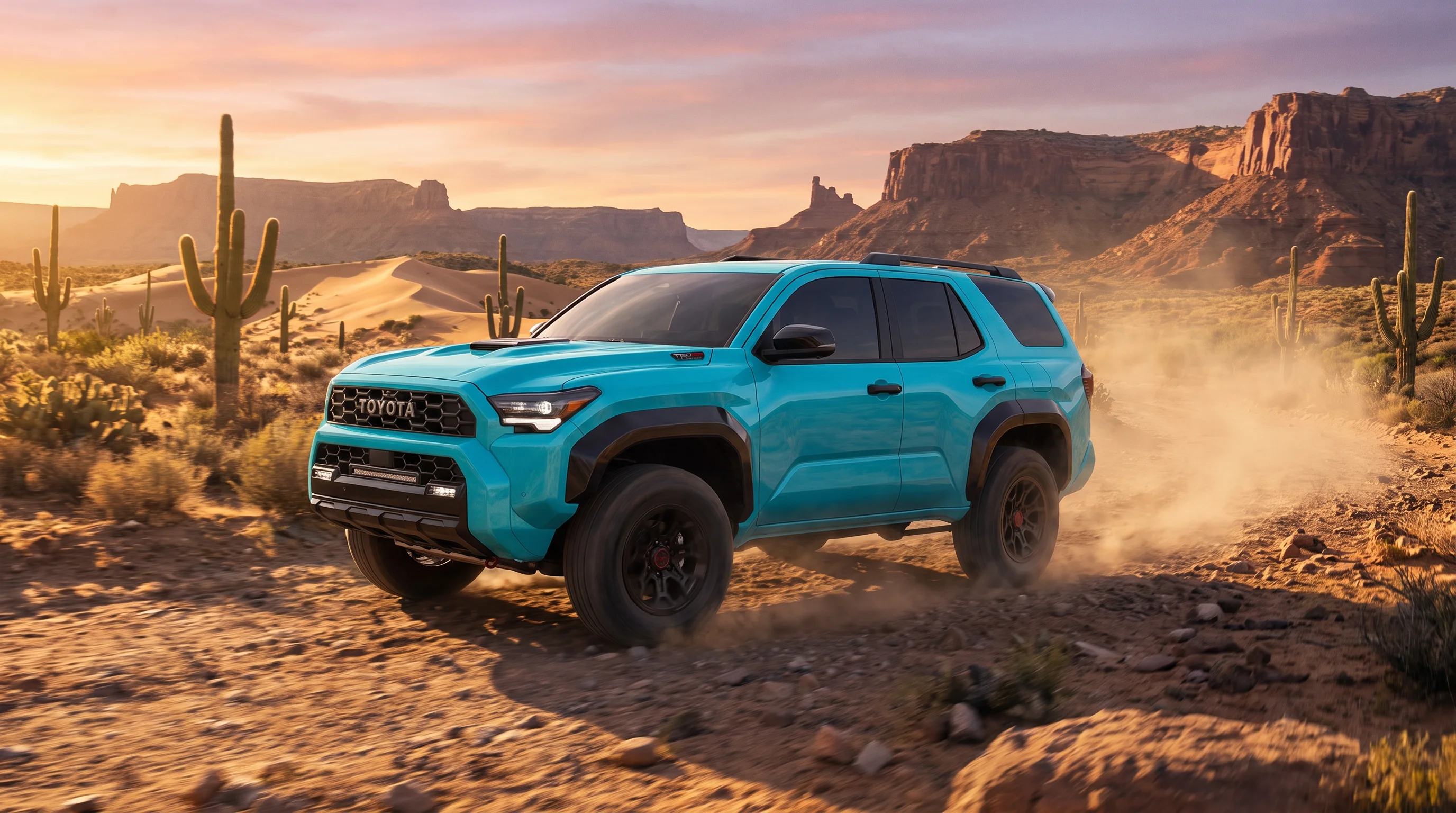
The 2026 Toyota 4Runner Limited and the 2026 Toyota 4Runner Limited i-FORCE MAX share the same luxury cabin. They share the same 6,000-pound tow rating. They even share the same EPA-estimated 24 highway MPG.
Maximum towing and payload capacity figures are based on properly equipped vehicles and vary by configuration. Do not exceed any weight rating. See your owner’s manual and the vehicle’s door-jamb label for specific capacities.
EPA-estimated fuel economy figures are for comparison purposes only. Your actual mileage will vary depending on driving conditions, how you drive and maintain your vehicle, battery age/condition, and other factors.
What separates them is $4,800 in TSRP, 148 lb-ft of torque, and one question: do you need a third row? The gas Limited starts at $57,695 TSRP and seats up to seven with the available third row. The hybrid Limited i-FORCE MAX starts at $62,495 TSRP and makes 326 horsepower, but it seats five only. Its battery sits beneath the cargo floor.
Total Suggested Retail Price (TSRP) for new vehicles includes manufacturer and distributor options and delivery, processing, and handling fees, which are subject to change at any time. TSRP excludes taxes, title, license, dealer-installed options, accessories, fees and charges. TSRP is not the dealer advertised price. Dealer prices will vary. The dealer sets the final price.
How Much Does Each 2026 4Runner Limited Cost?
The 2026 Toyota 4Runner Limited starts at $57,695 TSRP. The 2026 Toyota 4Runner Limited i-FORCE MAX starts at $62,495 TSRP. That is a $4,800 step up in TSRP.
Total Suggested Retail Price (TSRP) for new vehicles includes manufacturer and distributor options and delivery, processing, and handling fees, which are subject to change at any time. TSRP excludes taxes, title, license, dealer-installed options, accessories, fees and charges. TSRP is not the dealer advertised price. Dealer prices will vary. The dealer sets the final price.
One detail matters when you read that gap. The Limited’s starting price is for a two-wheel-drive configuration. The Limited i-FORCE MAX includes four-wheel drive as standard equipment. So the $4,800 TSRP gap covers both the hybrid powertrain and the drivetrain hardware, not the powertrain alone.
Where Each Grade Sits in the 2026 Lineup
Both grades sit near the top of a nine-grade lineup. Toyota lists the 2026 4Runner in SR5, TRD Sport, TRD Sport Premium, TRD Off-Road, TRD Off-Road Premium, Limited, Platinum, Trailhunter, and TRD Pro form, per the official Toyota 4Runner model page.
The i-FORCE MAX hybrid powertrain is available on the TRD Off-Road, TRD Off-Road Premium, and Limited. It is standard on the Platinum, Trailhunter, and TRD Pro. For a full breakdown of where every grade lands, see our 2026 Toyota 4Runner trims and pricing guide.
Drivetrain Availability
The gas Limited can be configured with two-wheel drive or four-wheel drive. The Limited i-FORCE MAX comes standard with four-wheel drive.
It is the Limited i-FORCE MAX that adds Toyota’s full-time four-wheel-drive system with an electronic locking center differential. Four-wheel-drive 4Runners use an electronically controlled two-speed transfer case with high and low range, Active Traction Control (A-TRAC), and an automatic limited-slip differential, as detailed in Toyota’s 2026 4Runner product release.
| Specification | 2026 4Runner Limited | 2026 4Runner Limited i-FORCE MAX |
|---|---|---|
| Starting TSRP | $57,695 TSRP | $62,495 TSRP |
| Engine | 2.4L turbocharged i-FORCE four-cylinder | 2.4L turbocharged i-FORCE MAX hybrid four-cylinder |
| Horsepower | 278 hp at 6,000 rpm | 326 hp net combined |
| Torque | 317 lb-ft at 1,700 rpm | 465 lb-ft |
| Transmission | 8-speed automatic | 8-speed automatic |
| Drivetrain | Two-wheel drive or four-wheel drive | Four-wheel drive standard |
Total Suggested Retail Price (TSRP) for new vehicles includes manufacturer and distributor options and delivery, processing, and handling fees, which are subject to change at any time. TSRP excludes taxes, title, license, dealer-installed options, accessories, fees and charges. TSRP is not the dealer advertised price. Dealer prices will vary. The dealer sets the final price.
Performance: i-FORCE vs. i-FORCE MAX
The Limited i-FORCE MAX produces 326 horsepower and 465 lb-ft of torque. The gas Limited produces 278 horsepower and 317 lb-ft. The hybrid gains 48 horsepower and 148 lb-ft.
Both grades start from the same foundation. Toyota pairs a 2.4-liter turbocharged four-cylinder with an eight-speed automatic transmission in each one. Both sit in the body-on-frame TNGA-F chassis that the 4Runner shares with the Tacoma, Tundra, Land Cruiser, and Sequoia. The gas Limited delivers its 278 horsepower at 6,000 rpm and its 317 lb-ft at 1,700 rpm.
The i-FORCE MAX adds an electric motor and a 1.87-kWh nickel-metal hydride battery to that turbocharged base. The extra torque arrives low in the rev range. That is where it matters most: merging onto I-20, pulling a loaded trailer away from a stop, or climbing a grade without the transmission hunting for gears.
Both grades also receive adaptive variable suspension, which Toyota tunes for on-road refinement rather than trail articulation.
EPA-Estimated Fuel Economy: Where the Hybrid Wins and Where It Doesn’t
The Limited i-FORCE MAX carries an EPA-estimated 23 city / 24 highway / 23 combined MPG rating. The four-wheel-drive gas Limited carries an EPA-estimated 20 city / 24 highway / 21 combined MPG rating.
EPA-estimated fuel economy figures are for comparison purposes only. Your actual mileage will vary depending on driving conditions, how you drive and maintain your vehicle, battery age/condition, and other factors.
The hybrid’s advantage sits entirely in city driving, where the electric motor handles low-speed work. That is 23 MPG against 20. On the highway, the two are identical at an EPA-estimated 24 MPG.
The takeaway is simple. If most of your weekly mileage runs along LBJ Freeway or I-35E at cruising speed, the i-FORCE MAX will not return better fuel economy than the gas Limited.
Two-wheel-drive gas Limited models carry an EPA-estimated 20 city / 24 highway / 22 combined MPG rating. Both grades draw from a 19.0-gallon fuel tank. Both are engineered to run on regular unleaded fuel, so neither carries a premium-fuel penalty at the pump. Official ratings are published at fueleconomy.gov.
| Specification | 2026 4Runner Limited | 2026 4Runner Limited i-FORCE MAX |
|---|---|---|
| EPA-Estimated MPG (four-wheel drive) | 20 city / 24 highway / 21 combined | 23 city / 24 highway / 23 combined |
| EPA-Estimated MPG (two-wheel drive) | 20 city / 24 highway / 22 combined | Not offered — four-wheel drive standard |
| Fuel Tank Capacity | 19.0 gallons | 19.0 gallons |
| Recommended Fuel | Regular unleaded | Regular unleaded |
EPA-estimated fuel economy figures are for comparison purposes only. Your actual mileage will vary depending on driving conditions, how you drive and maintain your vehicle, battery age/condition, and other factors.
Cargo, Seating, and Towing Capacity
The gas Limited offers 48.4 cubic feet of cargo volume behind the second row. It seats up to seven with the available third row. The Limited i-FORCE MAX offers 42.6 cubic feet and seats five.
Why the Hybrid Gives Up Space
This is the largest practical difference between the two grades, and it comes down to battery placement. The i-FORCE MAX mounts its hybrid battery beneath the rear cargo floor.
That raises the load floor and trims cargo volume to 42.6 cubic feet behind the second row. It also rules out the third-row seat entirely. Toyota offers the available third row only on the gas SR5 and Limited grades.
With the second row folded, the gas Limited opens up to 90.2 cubic feet. The Limited i-FORCE MAX tops out at approximately 82.6 cubic feet.
Towing Is a Dead Heat
Both grades are rated to tow up to 6,000 pounds when properly equipped. That is the maximum rating in the 2026 4Runner lineup. The Platinum, Trailhunter, and TRD Pro come in lower at 5,800 pounds because of their added equipment weight.
The hybrid does not tow more on paper. Its 465 lb-ft does change how a loaded trailer feels behind you. Both grades can add the available Tow Technology Package, which brings an integrated trailer brake controller, a digital rear-view mirror, and Trailer Back-Up Guide with Straight Path Assist.
| Specification | 2026 4Runner Limited | 2026 4Runner Limited i-FORCE MAX |
|---|---|---|
| Maximum Seating | 5, or 7 with available third row | 5 |
| Cargo Behind Second Row | 48.4 cubic feet | 42.6 cubic feet |
| Maximum Cargo Volume | 90.2 cubic feet | Approximately 82.6 cubic feet |
| Maximum Towing Capacity | 6,000 pounds | 6,000 pounds |
Maximum towing and payload capacity figures are based on properly equipped vehicles and vary by configuration. Do not exceed any weight rating. See your owner’s manual and the vehicle’s door-jamb label for specific capacities.
Technology and Safety Features
Both grades carry a 14-inch Toyota Audio Multimedia touchscreen, a 12.3-inch digital gauge cluster, 14-speaker JBL Premium Audio, and Toyota Safety Sense 3.0 as standard equipment.
Shared Cabin Equipment
Cabin equipment is closely matched. Both grades include leather-trimmed heated and ventilated front seats, a driver’s seat memory system, a heated steering wheel, dual-zone automatic climate control, a power moonroof, and 20-inch machined-finish alloy wheels.
The JBL system includes an externally coupled subwoofer and the removable JBL FLEX portable speaker. It docks and charges in the dash, then works as a Bluetooth speaker outside the vehicle. Both grades also feature the 4Runner’s signature power rear window and a Smart Key System with push-button start.
A hands-free power liftgate, a Panoramic View Monitor, a digital rearview mirror, and power-extending running boards are available on both grades.
What’s Exclusive to the Hybrid
One technology feature belongs to the hybrid alone. The Limited i-FORCE MAX includes a standard 2,400-watt AC power supply in the cabin and cargo area. It is useful for running tools or camp equipment away from an outlet. The gas Limited does not offer it.
Toyota Safety Sense 3.0
Toyota Safety Sense 3.0 is standard across the entire 2026 4Runner lineup. Toyota’s suite includes Pre-Collision System with Pedestrian Detection, Lane Departure Alert with Steering Assist, Full-Speed Range Dynamic Radar Cruise Control, Lane Tracing Assist, Road Sign Assist, Automatic High Beams, and Proactive Driving Assist.
Blind Spot Monitor with Rear Cross-Traffic Alert is also standard, in addition to the Toyota Safety Sense suite.
| Feature | 2026 4Runner Limited | 2026 4Runner Limited i-FORCE MAX |
|---|---|---|
| Toyota Audio Multimedia Touchscreen | 14-inch standard | 14-inch standard |
| Digital Gauge Cluster | 12.3-inch standard | 12.3-inch standard |
| JBL Premium Audio | 14 speakers with JBL FLEX | 14 speakers with JBL FLEX |
| Toyota Safety Sense 3.0 | Standard | Standard |
| Blind Spot Monitor with Rear Cross-Traffic Alert | Standard | Standard |
| Adaptive Variable Suspension | Standard | Standard |
| Panoramic View Monitor | Available | Available |
| 2,400-Watt AC Power Supply | Not offered | Standard |
Driver-assistance and advanced safety systems are supplemental aids and are not substitutes for safe and attentive driving. Availability, operation, and effectiveness vary by trim and equipment and depend on factors including road, weather, traffic, and vehicle condition. Always keep your hands on the wheel and your eyes on the road. See your owner’s manual for system limitations and details.
Warranty and Maintenance Coverage
Coverage Every 2026 4Runner Receives
Every 2026 Toyota 4Runner carries a 36-month/36,000-mile basic new-vehicle warranty and a 60-month/60,000-mile powertrain warranty. Corrosion perforation coverage runs 60 months with no mileage limitation.
ToyotaCare covers normal factory-scheduled maintenance for two years or 25,000 miles, whichever comes first. It also includes two years of unlimited-mileage Roadside Assistance.
Added Coverage on the Hybrid
The Limited i-FORCE MAX adds electrified-component coverage the gas Limited does not receive. Hybrid-related components are covered for eight years or 100,000 miles, whichever comes first.
The hybrid battery is covered for 10 years or 150,000 miles, whichever comes first. That coverage transfers to a subsequent owner.
| Coverage | 2026 4Runner Limited | 2026 4Runner Limited i-FORCE MAX |
|---|---|---|
| Basic New-Vehicle Warranty | 36 months / 36,000 miles | 36 months / 36,000 miles |
| Powertrain Warranty | 60 months / 60,000 miles | 60 months / 60,000 miles |
| Corrosion Perforation | 60 months / no mileage limit | 60 months / no mileage limit |
| ToyotaCare Scheduled Maintenance | 2 years / 25,000 miles | 2 years / 25,000 miles |
| Roadside Assistance | 2 years / unlimited miles | 2 years / unlimited miles |
| Hybrid-Related Components | Not applicable | 8 years / 100,000 miles |
| Hybrid Battery | Not applicable | 10 years / 150,000 miles |
This information is provided for general educational purposes only and does not constitute legal advice. Warranty coverage depends on the specific terms of your vehicle’s warranty agreement. Consult your owner’s manual or a qualified legal professional for guidance on your individual situation.
Which 2026 4Runner Is Right for Dallas Drivers?
Choose the Limited
Pick the gas Limited if you want seven-passenger capability, maximum cargo room, or the lower entry price. It is the only one of the two that can be ordered with the available third row.
Choose the Limited i-FORCE MAX
Pick the hybrid if you want the most torque available in a 4Runner Limited, better city fuel economy, standard four-wheel drive, and onboard AC power for tools or camp equipment.
The $4,800 TSRP gap buys real capability. It just isn’t the capability many shoppers assume. The i-FORCE MAX does not improve highway fuel economy over the gas Limited, and it does not raise the tow rating.
What it delivers is 148 lb-ft of additional torque, a 3-MPG city advantage, standard four-wheel drive, a 2,400-watt power supply, and hybrid-component coverage through 100,000 miles.
What it costs you is 5.8 cubic feet of cargo space behind the second row and the third-row seat, which the hybrid cannot accommodate. For a Dallas family that occasionally needs seven seats, that single limitation decides the question. For a driver who tows, commutes in traffic, or wants the strongest powertrain Toyota offers in a Limited, the i-FORCE MAX earns its premium.
If you’re still narrowing the lineup, our 2026 Toyota 4Runner review covers the full grade walk, and our 2026 Toyota 4Runner interior guide breaks down cabin materials and layout in detail. Shoppers weighing the same powertrain question in Toyota’s truck lineup may also want to read our 2026 Toyota Tundra i-FORCE vs. i-FORCE MAX comparison.
Frequently Asked Questions
Is the 2026 Toyota 4Runner Limited better for cargo than the Limited i-FORCE MAX?
Yes. The gas 2026 Toyota 4Runner Limited offers 48.4 cubic feet of cargo volume behind the second row and 90.2 cubic feet with the second row folded. The Limited i-FORCE MAX drops to 42.6 cubic feet behind the second row and approximately 82.6 cubic feet maximum, because the hybrid battery is mounted beneath the rear cargo floor. That same battery placement is why the available third-row seat is offered on the gas Limited but not on the i-FORCE MAX.
Do both 2026 Toyota 4Runner Limited grades have the same towing capacity?
Yes. Both the 2026 Toyota 4Runner Limited and the 2026 Toyota 4Runner Limited i-FORCE MAX are rated to tow up to 6,000 pounds when properly equipped. That is the highest rating in the 2026 4Runner lineup; the Platinum, Trailhunter, and TRD Pro are rated at 5,800 pounds.
Maximum towing and payload capacity figures are based on properly equipped vehicles and vary by configuration. Do not exceed any weight rating. See your owner’s manual and the vehicle’s door-jamb label for specific capacities.
What is the price difference between the 4Runner Limited and the Limited i-FORCE MAX?
The 2026 Toyota 4Runner Limited starts at $57,695 TSRP and the 2026 Toyota 4Runner Limited i-FORCE MAX starts at $62,495 TSRP, a difference of $4,800. The Limited’s starting price reflects a two-wheel-drive configuration, while the Limited i-FORCE MAX includes four-wheel drive as standard, so the gap covers both the hybrid powertrain and the drivetrain.
Total Suggested Retail Price (TSRP) for new vehicles includes manufacturer and distributor options and delivery, processing, and handling fees, which are subject to change at any time. TSRP excludes taxes, title, license, dealer-installed options, accessories, fees and charges. TSRP is not the dealer advertised price. Dealer prices will vary. The dealer sets the final price.
Does the 2026 Toyota 4Runner Limited require premium fuel?
No. Both the 2.4-liter i-FORCE engine in the Limited and the i-FORCE MAX hybrid powertrain in the Limited i-FORCE MAX are engineered to run on regular unleaded fuel, which helps keep routine operating costs down.
Disclaimers
Total Suggested Retail Price (TSRP) for new vehicles includes manufacturer and distributor options and delivery, processing, and handling fees, which are subject to change at any time. TSRP excludes taxes, title, license, dealer-installed options, accessories, fees and charges. TSRP is not the dealer advertised price. Dealer prices will vary. The dealer sets the final price.
EPA-estimated fuel economy figures are for comparison purposes only. Your actual mileage will vary depending on driving conditions, how you drive and maintain your vehicle, battery age/condition, and other factors.
Maximum towing and payload capacity figures are based on properly equipped vehicles and vary by configuration. Do not exceed any weight rating. See your owner’s manual and the vehicle’s door-jamb label for specific capacities.
Driver-assistance and advanced safety systems are supplemental aids and are not substitutes for safe and attentive driving. Availability, operation, and effectiveness vary by trim and equipment and depend on factors including road, weather, traffic, and vehicle condition. Always keep your hands on the wheel and your eyes on the road. See your owner’s manual for system limitations and details.
This information is provided for general educational purposes only and does not constitute legal advice. Warranty coverage depends on the specific terms of your vehicle’s warranty agreement. Consult your owner’s manual or a qualified legal professional for guidance on your individual situation.