

2026 Toyota Grand Highlander vs. Highlander: Size, Space & Towing Compared
Choosing between the 2026 Toyota Grand Highlander and the 2026 Toyota Highlander is one of the more interesting decisions in Toyota’s three-row hybrid lineup—because for 2026, the usual “bigger costs more” logic doesn’t hold. Both are refined unibody hybrids from the same family, but they’re built for different priorities. This side-by-side breaks down size, space, towing, powertrains, pricing, safety, and value so Dallas families can decide which one fits.
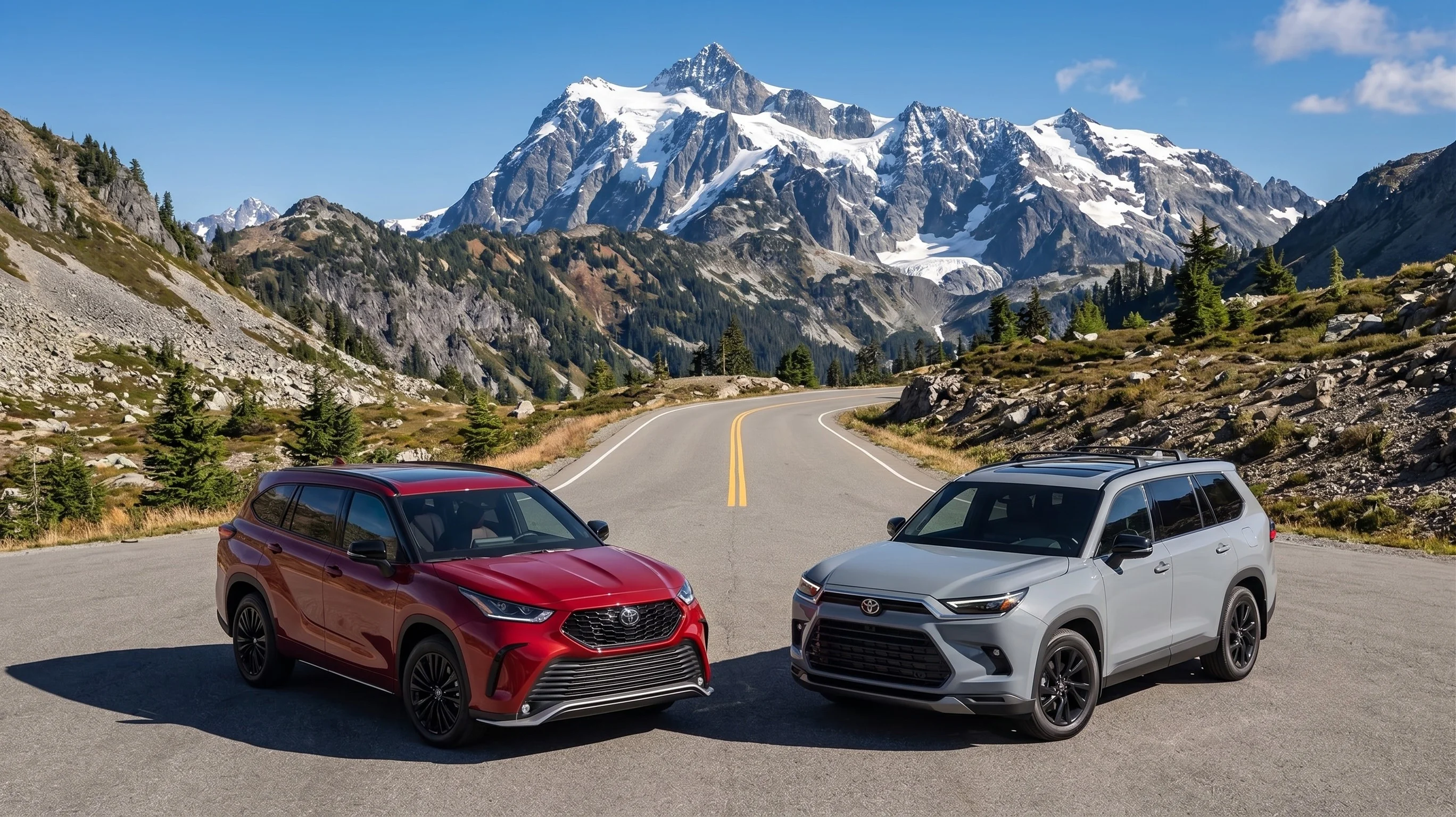
The Short Version: Which One Is Right for You?
- Choose the Grand Highlander if you want a genuinely adult-friendly third row, maximum cargo space, or the available 362-hp Hybrid MAX with 5,000-lb towing.
- Choose the Highlander if you prefer a tighter, easier-to-park footprint, standard all-wheel drive on every trim, and slightly better around-town efficiency.
- The 2026 surprise: the smaller Highlander Hybrid actually starts higher than the Grand Highlander Hybrid—so bigger doesn’t automatically mean pricier this year.
Size & Space: Grand Highlander vs. Highlander Dimensions
The most important difference between these two SUVs is size, and it’s most noticeable in the third row. The Highlander offers a cozy third row best suited to children or short trips, while the Grand Highlander—about six and a half inches longer with a longer wheelbase—delivers a third row adults can actually use on a road trip.
| Specification | 2026 Grand Highlander Hybrid | 2026 Highlander Hybrid |
|---|---|---|
| Length | 201.4 in | 194.9 in |
| Wheelbase | 116.1 in | 112.2 in |
| Third-row legroom | 33.5 in | 28.0 in |
| Cargo behind 3rd row | 20.6 cu ft | 16.0 cu ft |
| Max cargo (seats folded) | 97.5 cu ft | 84.3 cu ft |
| Curb weight (base hybrid) | 4,565 lbs | 4,595 lbs |
| Seating | 7 or 8 | 7 or 8 |
A few practical takeaways from the numbers:
- Third row: The Grand Highlander’s 33.5 inches of third-row legroom is 5.5 inches more than the Highlander’s 28 inches—the difference between “adults welcome” and “kids only.”
- Cargo: Behind the third row, the Grand Highlander holds 20.6 cubic feet versus 16.0—roughly an extra couple of suitcases. With all seats folded, the gap widens to 97.5 vs. 84.3 cubic feet.
- Seating: Both offer seven- or eight-passenger configurations. Eight-passenger bench seating is standard on the Grand Highlander’s lower trims and available on the Highlander Hybrid XLE; captain’s chairs (seven seats) come on the higher trims.
Shopping the full ranges? Explore the 2026 Grand Highlander lineup and the 2026 Highlander lineup to see what’s in stock at Legacy Toyota of Dallas.
Towing & Powertrains
Both SUVs share a 2.5-liter four-cylinder hybrid as their core powertrain, with nearly identical output. Where the Grand Highlander pulls ahead is its available Hybrid MAX—a turbocharged 2.4-liter hybrid paired with a six-speed automatic that the Highlander doesn’t offer at all.
| Specification | 2026 Grand Highlander Hybrid | 2026 Highlander Hybrid |
|---|---|---|
| Standard engine | 2.5L 4-cyl hybrid | 2.5L 4-cyl hybrid |
| Horsepower (standard hybrid) | 245 hp | 243 hp |
| Torque (standard hybrid) | 175 lb-ft | 175 lb-ft |
| Transmission | eCVT | eCVT |
| Drivetrain | FWD or AWD | AWD standard |
| Max towing (standard hybrid) | 3,500 lbs | 3,500 lbs |
| Available performance powertrain | Hybrid MAX — 362 hp / 400 lb-ft | Not available |
| Max towing (Hybrid MAX) | 5,000 lbs | Not available |
Two differences matter most here:
- Towing: With the standard hybrid, both tow up to 3,500 pounds. But the Grand Highlander’s available Hybrid MAX raises that to 5,000 pounds—enough for a small camper or boat—a capability the Highlander Hybrid simply doesn’t have.
- Drivetrain: The Highlander Hybrid comes with all-wheel drive standard on every trim. The Grand Highlander Hybrid offers front-wheel drive on the XLE and AWD elsewhere, so shoppers who don’t need AWD have a lower-cost, higher-mpg option.
Pricing & Trims: The 2026 Price Inversion
Here’s where 2026 gets interesting. For the first time, the smaller Highlander Hybrid starts higher than the larger Grand Highlander Hybrid—because Toyota dropped the Highlander’s base LE trim and made AWD standard, raising its entry point.
| 2026 Grand Highlander Hybrid | TSRP* | 2026 Highlander Hybrid | TSRP* |
|---|---|---|---|
| Hybrid LE (AWD) | $45,610* | — | — |
| Hybrid XLE | $46,780* | Hybrid XLE | $48,515* |
| Hybrid Limited | $53,110* | Hybrid Limited | $52,470* |
| Hybrid MAX Platinum | $60,175* | Hybrid Platinum | $56,170* |
Reading the ladder:
- Entry point: The Grand Highlander Hybrid LE opens the lineup below the Highlander Hybrid XLE—more vehicle for less money at the bottom of the range.
- Middle: The two Hybrid Limited trims land within about $640 of each other ($53,110 vs. $52,470), so the roomier Grand Highlander costs only a little more at this popular price point.
- Top: The Grand Highlander’s range-topping Hybrid MAX Platinum climbs higher than the Highlander Platinum—but you’re paying for the exclusive 362-hp turbo-hybrid powertrain and 5,000-lb towing, not just trim.
The Grand Highlander lineup also spreads across more configurations than the three-trim Highlander Hybrid range, including a Hybrid Nightshade (TSRP $54,090*) and a Hybrid MAX Limited (TSRP $56,090*) between the tiers shown above.
Fuel Economy (EPA-Estimated)
| EPA-Estimated MPG (city / hwy / combined) | 2026 Grand Highlander Hybrid | 2026 Highlander Hybrid |
|---|---|---|
| AWD | 36 / 32 / 34 | 35 / 35 / 35 |
| FWD (where offered) | 37 / 34 / 36 (XLE FWD) | N/A — AWD only |
The Highlander Hybrid holds a slight EPA-estimated combined-MPG edge (35 vs. 34) thanks to its lighter body, but the front-wheel-drive Grand Highlander Hybrid XLE actually posts the highest EPA-estimated figure of the group at 36 combined. In real-world terms, fuel costs between the two are close to a wash—you’re not paying a meaningful efficiency penalty to step up to the larger vehicle.
Safety & Driver Assistance
Both SUVs carry a full suite of standard active-safety features, but there’s a generational difference in the driver-assistance software, and their crash-test results differ slightly.
| Safety | 2026 Grand Highlander Hybrid | 2026 Highlander Hybrid |
|---|---|---|
| Driver-assist suite | Toyota Safety Sense 3.0 | Toyota Safety Sense 2.5+ |
| Notable additions | Proactive Driving Assist, Emergency Driving Stop System | Pre-collision, lane-keeping, radar cruise |
| NHTSA overall rating | 5 stars | 5 stars |
| IIHS crash results | “Good” in two crash tests; “Acceptable” small-overlap front & headlights | “Marginal” in updated moderate-overlap front test |
The Grand Highlander’s newer Toyota Safety Sense 3.0 adds Proactive Driving Assist and an Emergency Driving Stop System, which can bring the vehicle to a controlled stop if the driver becomes unresponsive—features the Highlander’s TSS 2.5+ doesn’t include. Both earn a 5-star overall NHTSA rating. Note that neither model is an IIHS Top Safety Pick for 2026.
Technology & Infotainment
Both SUVs run Toyota’s Audio Multimedia system with wireless Apple CarPlay and Android Auto, but the Grand Highlander is more generous with standard tech.
Grand Highlander
A 12.3-inch touchscreen is standard across the entire lineup, including the entry Hybrid LE. Higher trims add a 12.3-inch digital gauge cluster and a 10-inch color Head-Up Display, and the cabin includes seven USB-C ports across all three rows.
Highlander
Starts with an 8-inch touchscreen, with the 12.3-inch screen reserved for the Limited and Platinum trims. Higher trims add the JBL premium audio and digital gauge cluster.
If having the big screen and richer tech standard on the entry trim matters to you, the Grand Highlander delivers more without climbing the trim ladder.
Ownership Value: Warranty & Maintenance
Whichever you choose, both come backed by the same Toyota coverage—a genuine part of the value equation for a long-term family vehicle:
- Basic warranty: 3 years / 36,000 miles
- Powertrain: 5 years / 60,000 miles
- Hybrid system components: 8 years / 100,000 miles
- Hybrid battery: 10 years / 150,000 miles
- ToyotaCare: complimentary factory-scheduled maintenance for 2 years / 25,000 miles
Federal law also protects your warranty rights: under the Magnuson-Moss Warranty Act (15 U.S.C. §§ 2301–2312), a manufacturer generally cannot void your warranty simply because routine maintenance or repairs were performed by an independent shop.
The Verdict for Dallas Shoppers
Both are excellent three-row hybrids from the same family—the right pick comes down to how you use the third row, how much you tow, and how tight your parking is. Here’s the quick scorecard:
| What matters to you | Better pick |
|---|---|
| Adult-usable third row & max cargo | Grand Highlander |
| Maximum towing (up to 5,000 lbs) | Grand Highlander (Hybrid MAX) |
| Newest safety tech (TSS 3.0) | Grand Highlander |
| Lower starting price | Grand Highlander |
| Smaller, easier-to-park footprint | Highlander |
| Standard AWD on every trim | Highlander |
| Best combined fuel economy (AWD) | Highlander |
Best for most families: Grand Highlander
For most families comparing these two, the Grand Highlander is the stronger all-around pick: a usable adult third row, more cargo in every configuration, standard big-screen tech, the newest safety suite, and—remarkably for 2026—a lower starting price than the Highlander Hybrid. Add the available Hybrid MAX and it becomes the only one of the two that can tow 5,000 pounds.
Still a smart pick: Highlander
The Highlander makes a strong case for shoppers who want a more compact, easier-to-maneuver SUV, prize standard all-wheel drive on every trim, and rarely need the third row for adults. Its slight EPA-estimated combined-MPG edge is a bonus for high-mileage commuters.
The best next step: drive both
The best way to feel the difference—especially that third-row legroom—is to sit in both. See the full lineups below or reach out to schedule a side-by-side test drive.
Frequently Asked Questions
Is the 2026 Grand Highlander worth it over the standard Highlander?
For families who use the third row for adults or need maximum cargo, yes. The Grand Highlander adds 5.5 inches of third-row legroom and 4.6 cubic feet of cargo behind the third row, and for 2026 it actually starts lower than the Highlander Hybrid—so the roomier SUV can also be the more affordable entry point.
Which gets better fuel economy?
The Highlander Hybrid holds a narrow edge at an EPA-estimated 35 mpg combined versus an EPA-estimated 34 for the AWD Grand Highlander Hybrid. However, the front-wheel-drive Grand Highlander Hybrid XLE reaches an EPA-estimated 36 mpg combined—the highest of the group. Day to day, fuel costs are very close.
Which has more cargo space?
The Grand Highlander. It offers 20.6 cubic feet behind the third row versus 16.0 in the Highlander, expanding to 97.5 cubic feet with all seats folded (versus 84.3).
Which can tow more?
With the standard hybrid, both tow up to 3,500 pounds. Only the Grand Highlander offers the available Hybrid MAX powertrain, which raises towing to 5,000 pounds.
Disclaimers
Maximum towing and payload capacity figures are based on properly equipped vehicles and vary by configuration. Do not exceed any weight rating. See your owner’s manual and the vehicle’s door-jamb label for specific capacities.
Total Suggested Retail Price (TSRP) for new vehicles includes manufacturer and distributor options and delivery, processing, and handling fees, which are subject to change at any time. TSRP excludes taxes, title, license, dealer-installed options, accessories, fees and charges. TSRP is not the dealer advertised price. Dealer price will vary. The dealer sets the final price.
EPA-estimated fuel economy figures are for comparison purposes only. Your actual mileage will vary depending on driving conditions, how you drive and maintain your vehicle, battery age/condition, and other factors.
Driver-assist and safety systems are supplemental aids and are not a substitute for safe, attentive driving. Their effectiveness depends on weather, road, and traffic conditions and other factors. Always obey traffic laws and stay attentive to the road. See your owner’s manual for system details and limitations.
The warranty information above is provided for general educational purposes only and does not constitute legal advice. Warranty coverage depends on the specific terms of your vehicle’s warranty agreement. Consult your owner’s manual or a qualified legal professional for guidance on your individual situation.