

2026 Toyota Tundra vs. Ford F-150: Which Full-Size Truck Fits You?
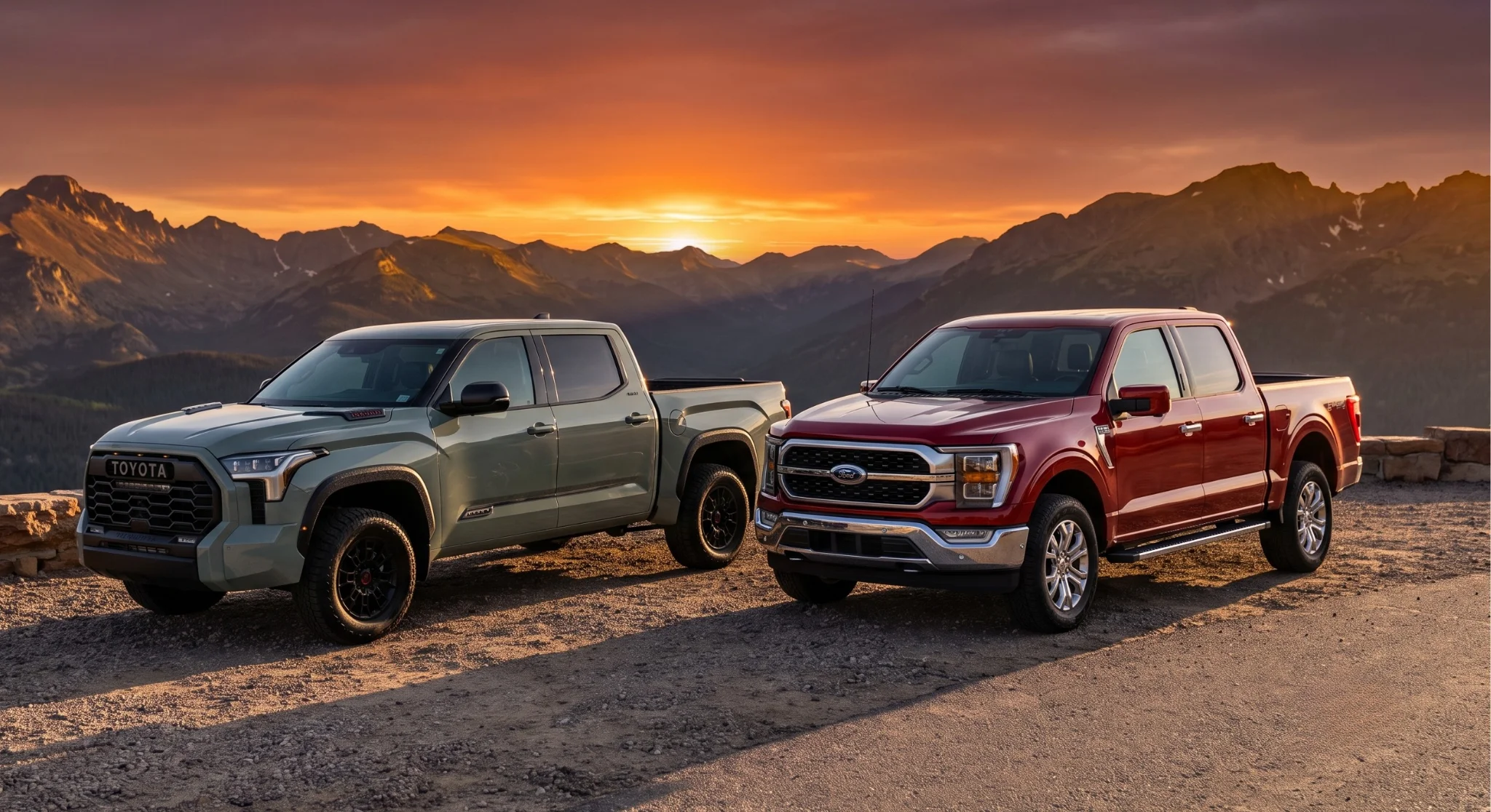
Choosing between the 2026 Toyota Tundra and the 2026 Ford F-150 means weighing two very different philosophies in the same segment. The F-150 is America’s long-running capability benchmark; the Tundra counters with ride refinement, available hybrid power, and Toyota’s ownership package. This comparison lays out the verified numbers for both trucks — including where the F-150 leads — so you can decide which one earns your driveway.
Towing & Payload — Winner: Ford F-150
For most truck shoppers, this is the first question — and credit where it’s due: the F-150 is the capability leader in this pairing when each truck is properly equipped.
| Capability (max, properly equipped) | 2026 Toyota Tundra | 2026 Ford F-150 |
|---|---|---|
| Max towing | 12,000 lbs | 13,500 lbs |
| Max payload | 1,940 lbs | 2,440 lbs |
| Standard trailer brake controller | Yes (integrated) | Available (Tow/Haul Package) |
| Seating | Up to 5 | Up to 5 |
Maximum towing and payload capacity figures are based on properly equipped vehicles and vary by configuration. Do not exceed any weight rating. See your owner’s manual and the vehicle’s door-jamb label for specific capacities.
How to read these numbers
- The F-150’s 13,500-lb tow and 2,440-lb payload lead the Tundra’s best figures — a genuine advantage if you tow heavy or haul frequently at the limit.
- The Tundra still tows a substantial 12,000 lbs and comes with a standard tow hitch receiver and integrated trailer brake controller for 2026.
- Both trucks reach their peak numbers only in specific cab, bed, and drivetrain configurations — match the spec to your actual load.
Engine & Performance — Winner: Toyota Tundra (Standard Power)
Both trucks moved to turbocharged and hybrid power, but their standard engines start from different places. Comparing each truck’s base engine head-to-head, the Tundra opens with more muscle.
| Powertrain | 2026 Toyota Tundra | 2026 Ford F-150 |
|---|---|---|
| Standard engine | i-FORCE 3.4L Twin-Turbo V6 | 2.7L EcoBoost V6 |
| Standard hp / torque | 389 hp / 479 lb-ft* | 325 hp / 400 lb-ft |
| Available upgrade | i-FORCE MAX 3.4L Twin-Turbo V6 Hybrid | 3.5L EcoBoost V6 |
| Upgrade hp / torque | 437 hp / 583 lb-ft | 400 hp / 500 lb-ft |
| Additional options | None (two-engine lineup) | 3.5L PowerBoost Hybrid V6 (430 hp / 578 lb-ft); 5.0L V8 (400 hp / 410 lb-ft) |
| Transmission | 10-speed automatic | 10-speed automatic |
| Drivetrain | RWD standard, 4WD available | RWD standard, 4WD available |
*389 hp / 479 lb-ft applies to SR5 and above; the base SR is rated 358 hp / 406 lb-ft.
What it means for you
- The Tundra’s standard V6 out-powers the F-150’s standard 2.7L on both horsepower and torque.
- Step up the lineup and the picture evens out — the F-150’s available 3.5L EcoBoost and the Tundra’s i-FORCE MAX hybrid both deliver strong, tow-ready torque.
- The F-150 offers the widest engine menu in the segment, including a V8 and a high-output Raptor powerplant the Tundra doesn’t match.
Pricing & Value — Winner: Toyota Tundra (Ownership Value)
Both lineups span work-truck value to top-tier luxury. Because trim-level pricing shifts with configuration and options, here are the verified starting and flagship points.
| Pricing | 2026 Toyota Tundra | 2026 Ford F-150 |
|---|---|---|
| Base trim starting price | From $43,355 (TSRP) | From $40,085 (MSRP) |
| Luxury flagship starting price | Capstone from $82,895 (TSRP) | Platinum from $71,595 (MSRP) |
| Performance halo | Not offered | Raptor R up to $113,725 (MSRP) |
The F-150 opens at a lower entry price and offers a wider price ceiling thanks to its performance trims. Where the Tundra pulls ahead is long-term value: the 2026 Tundra was named Best Resale Value in its class by Kelley Blue Book’s KBB.com, meaning it’s built to retain more of your investment at trade-in time.[1]
Total Suggested Retail Price (TSRP) for new vehicles includes manufacturer and distributor options and delivery, processing, and handling fees, which are subject to change at any time. TSRP excludes taxes, title, license, dealer-installed options, accessories, fees and charges. TSRP is not the dealer advertised price. Dealer price will vary. The dealer sets the final price.
Manufacturer’s Suggested Retail Price (MSRP) for new vehicles includes manufacturer and distributor options and delivery, process and handling fees, which may be subject to change at any time. MSRP excludes taxes, title, license and dealer installed options, accessories, fees and charges. MSRP is not the dealer advertised price. Dealer price will vary. The dealer sets the final price.
Fuel Economy — Even
Both trucks offer an available hybrid, and the two are closely matched on paper. The Tundra offers its i-FORCE MAX hybrid across much of the lineup, while the F-150’s PowerBoost hybrid holds a slight combined-MPG edge in its rated configuration.
| EPA-Estimated MPG | City | Hwy | Combined |
|---|---|---|---|
| Tundra gas i-FORCE (SR5–1794, 4×2) | 18 | 23 | 20 |
| Tundra i-FORCE MAX Hybrid (4×2) | 20 | 24 | 22 |
| Ford F-150 gas 2.7L EcoBoost (2WD) | 19 | 25 | 21 |
| Ford F-150 PowerBoost Hybrid (4×4) | 22 | 24 | 23 |
The F-150’s standard 2.7L EcoBoost posts strong highway numbers, and its available PowerBoost hybrid is the F-150’s efficiency leader — its EPA-estimated 23 combined MPG edges the Tundra i-FORCE MAX hybrid’s 22 combined. Where the Tundra pulls ahead is availability: its hybrid is offered across much of the lineup in both rear- and four-wheel drive, giving efficiency-minded buyers more ways to get it. Figures vary by engine, cab, and drivetrain, so confirm the rating for your exact build.
EPA-estimated fuel economy figures are for comparison purposes only. Your actual mileage will vary depending on driving conditions, how you drive and maintain your vehicle, battery age/condition, and other factors.
Safety — Winner: Toyota Tundra
Both trucks carry robust standard driver-assist suites, and both are credible on safety. The Tundra holds an edge in third-party recognition.
| Safety | 2026 Toyota Tundra | 2026 Ford F-150 |
|---|---|---|
| Standard driver-assist suite | Toyota Safety Sense 2.5 | Ford Co-Pilot360 2.0 |
| Automatic emergency braking | Standard (with pedestrian detection) | Standard (with pedestrian detection) |
| Blind spot monitoring | Available | Standard (with trailer coverage) |
| Hands-free highway driving | Not offered | Available BlueCruise (select trims) |
| 2026 IIHS Top Safety Pick | Yes (Crew Cab) | Not awarded |
Every Tundra’s standard Toyota Safety Sense 2.5 adds Pre-Collision System with Pedestrian Detection, Full-Speed Range Dynamic Radar Cruise Control, Lane Departure Alert with Steering Assist, Lane Tracing Assist, Road Sign Assist, and Automatic High Beams. The F-150 counters with a standard Co-Pilot360 2.0 suite and available BlueCruise hands-free driving — a feature the Tundra doesn’t offer. The 2026 Tundra Crew Cab is an Insurance Institute for Highway Safety (IIHS) Top Safety Pick.[2]
Technology — Even
The screen-size gap the spec sheets used to show has closed for 2026.
| Standard Tech | 2026 Toyota Tundra | 2026 Ford F-150 |
|---|---|---|
| Infotainment | Available 14-inch Toyota Audio Multimedia (8-inch standard on base trims) | Standard 12-inch SYNC 4 on every trim |
| Smartphone | Wireless Apple CarPlay & Android Auto | Wireless Apple CarPlay & Android Auto |
| Digital cluster | Available 12.3-inch | Available 12-inch |
| Over-the-air updates | Available | Standard |
Ride & Suspension — Winner: Toyota Tundra
Historically, empty full-size trucks rode stiffly over the rear axle. The Tundra addresses that at the source.
| Suspension | 2026 Toyota Tundra | 2026 Ford F-150 |
|---|---|---|
| Rear suspension | Multi-link with coil springs | Traditional leaf springs |
| Front suspension | Independent double-wishbone | Independent double-wishbone |
| Adaptive damping | Available (AVS on upper trims) | Available (select trims) |
| Air suspension | Standard on Capstone (load-leveling rear) | Not offered |
The Tundra’s coil-spring rear delivers a settled, SUV-like ride that many drivers notice first behind the wheel, while the F-150’s leaf-spring setup is a proven, work-first design that many buyers prefer for its simplicity and load behavior.
Cargo Bed & Utility — Even
Both trucks are built to work; they just build the bed differently.
- Tundra: Aluminum-reinforced Sheet-Molded Composite (SMC) bed that resists dents and corrosion, plus an available deck rail system with adjustable tie-down cleats.
- F-150: High-strength steel-and-aluminum body with a wide range of bed lengths and available trailering aids like Pro Trailer Backup Assist.
Ownership & Warranty — Winner: Toyota Tundra
Every new 2026 Tundra includes:
- ToyotaCare: complimentary factory-scheduled maintenance for 2 years or 25,000 miles, whichever comes first — covering oil changes, tire rotations, and multi-point inspections.
- 24-hour Roadside Assistance for 2 years with unlimited miles.
- Standard warranty: 3 years / 36,000 miles basic and 5 years / 60,000 miles powertrain, with hybrid components covered 8 years / 100,000 miles.
Category Scorecard
| Category | Advantage |
|---|---|
| Max towing & payload | F-150 |
| Standard engine power | Tundra |
| Resale value & ownership | Tundra |
| Fuel economy (hybrid) | Even |
| Safety recognition | Tundra |
| Technology | Even |
| Ride & suspension | Tundra |
| Cargo bed & utility | Even |
The Verdict
The F-150 earns its reputation where it counts most for heavy-duty users — it out-tows and out-hauls the Tundra at the top of the range, opens at a lower entry price, and offers the widest engine and trim menu in the segment. If your buying decision comes down to maximum trailer weight or a specific powertrain, the Ford deserves a serious look.
For most Dallas-area drivers who split their weeks between commuting, family duty, and weekend hauling, the 2026 Tundra makes the stronger all-around case: more standard power, a smoother coil-spring ride, a widely available hybrid with competitive efficiency, a 2026 IIHS Top Safety Pick, and class-best resale value backed by standard ToyotaCare. It’s a truck that feels refined every day and holds its worth for years.
The best way to settle it is from behind the wheel. Explore the new Tundra lineup or read our full 2026 Toyota Tundra review, then come see how it drives.
Frequently Asked Questions
Does the Ford F-150 tow more than the Toyota Tundra?
Yes. When each truck is properly equipped, the 2026 F-150 tows up to 13,500 lbs and the Tundra up to 12,000 lbs, so the F-150 leads on maximum towing. Both reach their peak ratings only in specific configurations, so match the build to your load.
Which truck has better fuel economy?
They’re closely matched. The Tundra i-FORCE MAX hybrid is rated at an EPA-estimated 20 city / 24 highway / 22 combined MPG (4×2), and the F-150 PowerBoost hybrid is rated at an EPA-estimated 22 city / 24 highway / 23 combined MPG (4×4), a slight combined-MPG edge for the Ford. The Tundra counters with hybrid availability across much of its lineup in both rear- and four-wheel drive. Ratings vary by configuration, so confirm the figure for your exact build.
Is the 2026 Toyota Tundra a safe truck?
The 2026 Tundra Crew Cab is a 2026 IIHS Top Safety Pick and comes standard with Toyota Safety Sense 2.5, a suite that includes automatic emergency braking with pedestrian detection, dynamic radar cruise control, and lane-keeping assistance.
Which truck holds its value better?
The 2026 Tundra was named Best Resale Value in its class by Kelley Blue Book’s KBB.com, which points to stronger long-term value retention at trade-in or resale.
This comparison is provided for general informational purposes only and reflects manufacturer data available at the time of writing. Specifications, pricing, and availability are subject to change. Confirm current details and configuration-specific figures with Legacy Toyota of Dallas.
Disclaimers
Maximum towing and payload capacity figures are based on properly equipped vehicles and vary by configuration. Do not exceed any weight rating. See your owner’s manual and the vehicle’s door-jamb label for specific capacities.
Total Suggested Retail Price (TSRP) for new vehicles includes manufacturer and distributor options and delivery, processing, and handling fees, which are subject to change at any time. TSRP excludes taxes, title, license, dealer-installed options, accessories, fees and charges. TSRP is not the dealer advertised price. Dealer price will vary. The dealer sets the final price.
Manufacturer’s Suggested Retail Price (MSRP) for new vehicles includes manufacturer and distributor options and delivery, process and handling fees, which may be subject to change at any time. MSRP excludes taxes, title, license and dealer installed options, accessories, fees and charges. MSRP is not the dealer advertised price. Dealer price will vary. The dealer sets the final price.
EPA-estimated fuel economy figures are for comparison purposes only. Your actual mileage will vary depending on driving conditions, how you drive and maintain your vehicle, battery age/condition, and other factors.
This comparison is provided for general informational purposes only and reflects manufacturer data available at the time of writing. Specifications, pricing, and availability are subject to change. Confirm current details and configuration-specific figures with Legacy Toyota of Dallas.