

2026 Toyota Camry MPG & Fuel Efficiency Guide
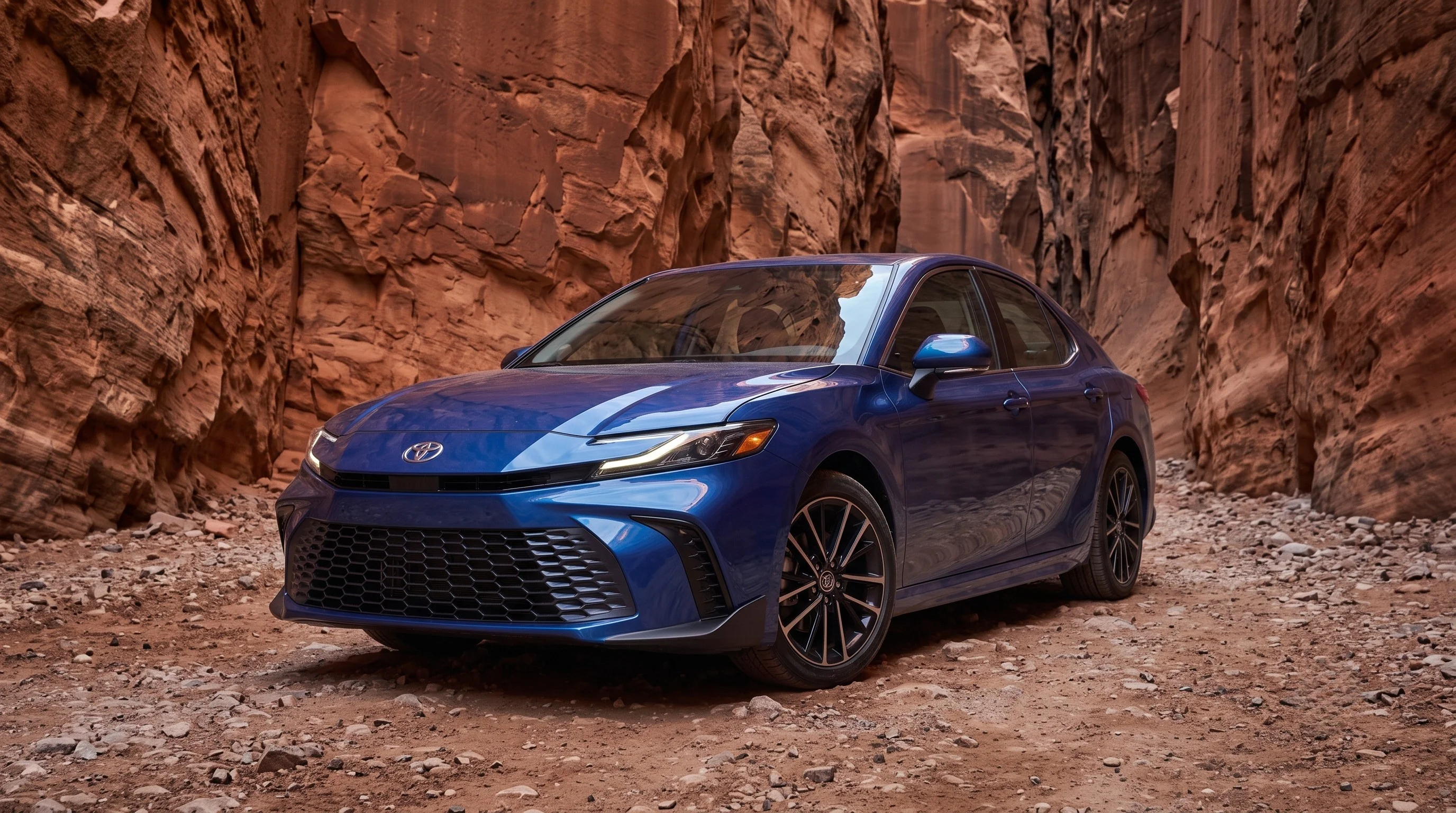
This guide breaks down the 2026 Toyota Camry’s fuel efficiency for Dallas-area shoppers — EPA-Estimated MPG by trim, real-world results, driving range, and the drive modes that shape it. The big picture first: this generation is fully hybrid across every trim, so a traditional non-hybrid gasoline engine is no longer offered. Every 2026 Camry pairs a 2.5L four-cylinder engine with Toyota’s fifth-generation Hybrid System and electric motor support, routing power through an electronically controlled continuously variable transmission (eCVT). The result is an EPA-Estimated 51 mpg combined at the top of the lineup, instant electric torque off the line, and everyday running on regular unleaded fuel.
2026 Toyota Camry MPG by Trim
How much fuel you save depends on the configuration you choose. Wheel size and suspension tuning influence aerodynamic drag and rolling resistance. That’s why the entry LE leads the lineup on its lighter 16-inch wheels, while the sportier trims ride on larger 18- and 19-inch wheels. Front-wheel drive is standard on every trim, and Electronic On-Demand All-Wheel Drive is available across the lineup.
| Trim | FWD (EPA-Estimated city / hwy / combined) | AWD (EPA-Estimated city / hwy / combined) |
|---|---|---|
| LE | 52 / 49 / 51 mpg | 50 / 49 / 50 mpg |
| SE | 47 / 45 / 46 mpg | 46 / 46 / 46 mpg |
| Nightshade | 47 / 45 / 46 mpg | 46 / 46 / 46 mpg |
| XLE | 47 / 45 / 46 mpg | 46 / 46 / 46 mpg |
| XSE | 47 / 45 / 46 mpg | 43 / 43 / 43 mpg |
EPA-estimated fuel economy figures are for comparison purposes only. Your actual mileage will vary depending on driving conditions, how you drive and maintain your vehicle, battery age/condition, and other factors.
The base LE with front-wheel drive is the efficiency champion at an EPA-Estimated 52 city / 49 highway / 51 combined mpg. The SE, Nightshade, XLE, and XSE with front-wheel drive each return an EPA-Estimated 47 city / 45 highway / 46 combined mpg. Choosing all-wheel drive trades only a small amount of efficiency. The LE AWD still delivers an EPA-Estimated 50 combined mpg. The SE, Nightshade, and XLE AWD hold at an EPA-Estimated 46 combined mpg, while the XSE AWD comes in at 43 combined mpg.
Every 2026 Camry stores captured braking energy in a compact lithium-ion hybrid battery positioned beneath the rear seats, which helps preserve a practical 15.1 cubic feet of trunk space. That stored energy lets the gas engine shut off frequently during low-speed coasting and stop-and-go traffic, which is a big reason the city ratings are so strong.
Real-World MPG: How the Camry Performs on the Road
EPA numbers come from controlled lab cycles, so how does the Camry do in everyday driving? On its standardized real-world evaluation route, Edmunds observed 45.9 mpg from a front-wheel-drive XSE — essentially matching that trim’s 46 mpg EPA-Estimated combined rating, and ahead of the hybrid Honda Accord they tested. Because the XSE sits toward the lower end of the Camry’s EPA ratings, the higher-rated LE and mid-lineup trims carry even more efficiency headroom.
EPA-estimated fuel economy figures are for comparison purposes only. Your actual mileage will vary depending on driving conditions, how you drive and maintain your vehicle, battery age/condition, and other factors.
How Electronic On-Demand AWD Affects Your Camry Fuel Economy
Wondering how all-wheel drive changes your trips to the pump? Rather than heavy driveshafts and a transfer case, the 2026 Camry uses an Electronic On-Demand All-Wheel Drive system with a dedicated electric motor on the rear axle. When the system detects front-wheel slip, the rear motor engages to send torque rearward, raising combined output to 232 horsepower.
Because there are no mechanical linkages tying the axles together, the weight penalty stays low, so the dip in fuel economy is modest. Across the lineup, the AWD ratings land within a few mpg of their front-wheel-drive counterparts. The LE AWD’s EPA-Estimated 50 combined mpg is exceptional for an all-wheel-drive midsize sedan. The system adds confident traction on wet pavement and slick surfaces without giving up the core benefits of the hybrid powertrain.
Powertrain, Range, and Fuel Requirements
Every 2026 Camry shares the same hybrid powertrain, so the driving experience is consistent from LE to XSE.
| Specification | Detail |
|---|---|
| Engine | 2.5L four-cylinder hybrid |
| Horsepower | 225 hp (FWD) / 232 hp (AWD) |
| Torque | 163 lb-ft |
| Transmission | Electronically controlled CVT (eCVT) |
| Drivetrain | Front-wheel drive standard; Electronic On-Demand AWD available |
With a 13.0-gallon fuel tank feeding an efficient hybrid system, the Camry delivers a long cruising range that means fewer stops on road trips. Driving the front-wheel-drive LE, you can expect an EPA-Estimated driving range of about 663 miles on a full tank. Even the sportier trims return roughly 560 to 600 miles between fill-ups.
There’s no need to pay for premium at the pump. The hybrid system is designed to run on regular unleaded with an octane rating of 87 or higher. Using premium provides no measurable gain in performance or economy. Sticking with regular unleaded keeps your ownership costs low.
Camry Drive Modes and EV Capability
Yes, you can tailor the Camry’s character on the fly. The 2026 Camry features a 4-Mode Drive Switch, and each mode is a button press away:
- Eco Mode: optimizes throttle response and climate operation to prioritize fuel economy — ideal for highway cruising and daily commuting.
- Normal Mode: the default balance of efficiency and acceleration for everyday driving.
- Sport Mode: sharpens throttle response and steering feel so you can lean on the combined power of the engine and electric motors.
- EV Mode: enables all-electric driving at low speeds for short distances when the hybrid battery has sufficient charge.
Running Sport mode for spirited driving temporarily lowers your average fuel economy because it keeps the gas engine engaged longer for maximum power. It doesn’t permanently change efficiency — switch back to Normal or Eco and the system returns to its high-efficiency behavior.
Hybrid Battery Coverage and Long-Term Efficiency
A hybrid’s fuel economy depends on a healthy battery, and Toyota’s factory coverage backs the 2026 Camry’s hybrid system for the long haul. Hybrid-related components are covered for 8 years / 100,000 miles, and the hybrid battery itself carries 10 years / 150,000 miles of coverage. That long runway matters for an efficiency-minded buyer: a well-maintained hybrid battery keeps delivering the Camry’s EPA-Estimated fuel economy deep into ownership, so the fuel savings you see on day one hold up over the years.
This information is provided for general educational purposes only and does not constitute legal advice. Warranty coverage depends on the specific terms of your vehicle’s warranty agreement. Consult your owner’s manual or a qualified legal professional for guidance on your individual situation.
Quick Answers Before You Visit
Does the 2026 Toyota Camry have a plug-in hybrid option?
No. The 2026 Camry is a conventional hybrid, not a plug-in. It recharges its own hybrid battery automatically through regenerative braking and engine operation, so you never plug it in.
Can I drive the Camry if the hybrid battery dies?
The hybrid traction battery is essential to how the Camry operates — it helps start the gas engine and manage the electronic transmission. If the traction battery is fully depleted or fails, the vehicle is not designed to run on gasoline alone, so a functioning hybrid battery is required.
Experience the All-Hybrid 2026 Camry at Legacy Toyota of Dallas
The 2026 Camry pairs head-turning style with an efficient, hybrid-only powertrain — whether your goal is slashing weekly fuel costs or enjoying a smoother, more refined commute around South Dallas, Arlington, Desoto, Duncanville, and Waxahachie. Our team can help you match a trim to your driving needs and set up a test drive so you can feel the fifth-generation hybrid system for yourself. For a closer look at features beyond efficiency, read our 2026 Toyota Camry review, or explore the full Toyota research hub.
EPA-estimated fuel economy figures are for comparison purposes only. Your actual mileage will vary depending on driving conditions, how you drive and maintain your vehicle, battery age/condition, and other factors.
This information is provided for general educational purposes only and does not constitute legal advice. Warranty coverage depends on the specific terms of your vehicle’s warranty agreement. Consult your owner’s manual or a qualified legal professional for guidance on your individual situation.
0 comment(s) so far on 2026 Toyota Camry MPG & Fuel Efficiency Guide