

Toyota Hybrid vs. Plug-in Hybrid vs. EV: What Dallas Buyers Need to Know
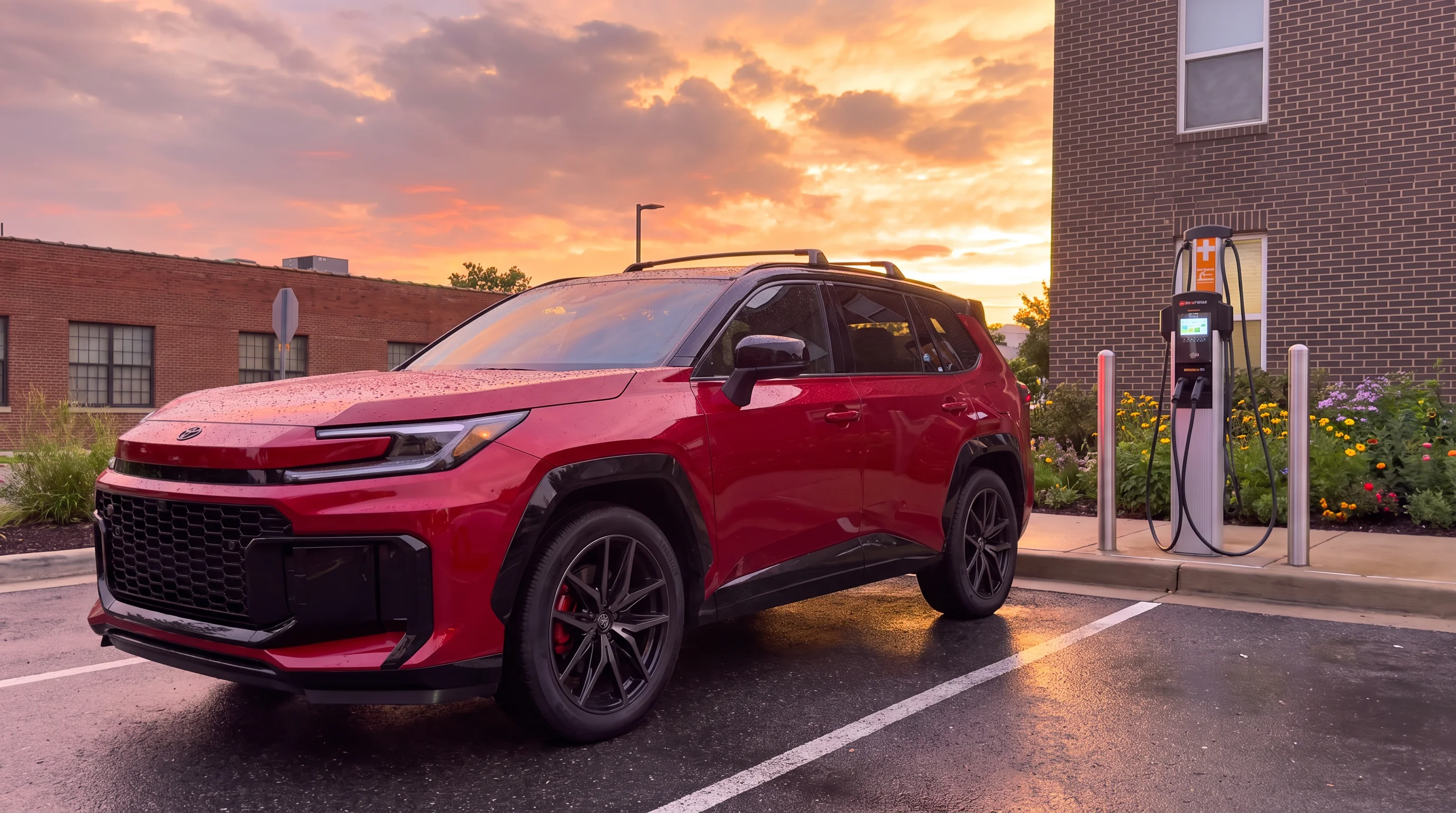
A Toyota hybrid (HEV) pairs a gasoline engine with an electric motor and recharges itself through regenerative braking — it never plugs in. A plug-in hybrid (PHEV) adds a larger battery and a charge port, delivering an EPA-estimated 39 to 54 miles of all-electric driving depending on the model and grade before switching to standard hybrid operation. A battery electric vehicle (BEV) runs entirely on electricity, requires plug-in charging, and uses no gasoline at all.
Toyota builds all three. Choosing between them comes down to two questions: how far you drive in a day, and whether you can plug in where you park.
The Short Answer: HEV vs. PHEV vs. BEV
| Hybrid (HEV) | Plug-in Hybrid (PHEV) | Electric (BEV) | |
|---|---|---|---|
| Plugs in? | No | Yes (optional) | Yes (required) |
| Uses gasoline? | Yes | Yes, after EV range | No |
| Electric-only range (EPA-estimated) | Short bursts | 39–54 miles | 236–314 miles |
| Charging equipment | None needed | Level 1 or Level 2 | Level 1, Level 2, DC fast |
| Best for | High-mileage drivers with no plug access | Under-50-mile daily commutes with home charging | Drivers with dedicated charging who want no gas stops |
EPA-estimated fuel economy figures are for comparison purposes only. Your actual mileage will vary depending on driving conditions, how you drive and maintain your vehicle, battery age/condition, and other factors.
How Each Powertrain Works
Hybrid Electric Vehicle (HEV)
A Toyota hybrid uses a gasoline engine and an electric motor together, with the system automatically selecting or blending power sources based on speed and demand. The high-voltage battery recharges itself through regenerative braking and direct generation from the engine. There is no charge port, so fueling routines do not change at all.
- Refuels at any standard gas station
- Recovers energy automatically through regenerative braking
- Improves efficiency over gas-only equivalents, especially in city driving
- Requires no home or public charging equipment
Plug-in Hybrid Electric Vehicle (PHEV)
A Toyota PHEV carries a significantly larger lithium-ion battery plus an external charge port alongside the gas engine. Fully charged, it operates as an electric vehicle for short and medium trips. Once the battery depletes, it shifts into standard self-charging hybrid mode without stopping.
- Dual flexibility — charge port and gas tank
- 39 to 54 miles of EPA-estimated EV range depending on model and grade
- Automatic transition to gas-electric hybrid operation when the battery depletes
- No charging stops required on long road trips
Battery Electric Vehicle (BEV)
A Toyota BEV replaces the engine, transmission, exhaust, and fuel tank with electric motors and a traction battery built into the chassis. All drive power comes from plugging in. Acceleration is immediate, operation is near-silent, and there are no tailpipe emissions.
- Pure electric operation with zero fuel consumption
- Charges via household outlet, Level 2, or DC fast charging
- Fewer mechanical moving parts than a combustion powertrain
- Smooth, linear acceleration from instant motor torque
How Charging Works: EV vs. Plug-in Hybrid
A Toyota BEV depends on external charging as its only energy source. A Toyota PHEV uses charging to unlock its electric range but can operate indefinitely as a hybrid on gasoline if no charger is available. Every Toyota BEV and PHEV comes with a dual-voltage Level 1/Level 2 charging cable that works with a standard household outlet or a 240-volt Level 2 charger.
Charging Levels at a Glance
| Level 1 (120V) | Level 2 (240V) | DC Fast Charging | |
|---|---|---|---|
| 2026 Prius Plug-in Hybrid | About 11 hours | About 4 hours | Not supported |
| 2026 RAV4 Plug-in Hybrid | Overnight | About 2.5 hours on XSE and Woodland; about 3.5 to 4 hours on SE and GR Sport | XSE and Woodland only |
| 2026 Toyota BEVs (bZ, bZ Woodland, C-HR) | Overnight top-ups only | Overnight full charge | 10–80% in about 30 minutes |
The Charge Port Changed for 2026
Every 2026 Toyota BEV — bZ, bZ Woodland, and C-HR — now uses a native North American Charging System (NACS) port, giving direct access to NACS-compatible public fast-charging networks. All three also step up to an 11-kW onboard AC charger and include a dual-voltage charging cable. All three add battery preconditioning, which heats the pack to an optimal temperature ahead of DC fast charging to shorten charging times in cold weather.
On the plug-in hybrid side, the RAV4 Plug-in Hybrid XSE and Woodland grades add DC fast charging with the same 11-kW onboard charger, reaching 10–80% in roughly 30 minutes. The SE and GR Sport grades charge on Level 1 and Level 2 only.
Batteries and Texas Heat
Summer heat increases cabin cooling demand, which draws from the high-voltage battery. At typical summer temperatures the effect on range is real but modest — AAA testing found roughly an 8.5% range reduction at 95 degrees, and Recurrent’s analysis measured around 5% at 90 degrees. Above 100 degrees, a threshold Dallas reaches regularly, Recurrent’s data shows a steeper drop of about 17 to 18%. Parking in shade or a garage during peak heat helps maintain consistent charging speed and long-term pack health.
EPA-estimated fuel economy figures are for comparison purposes only. Your actual mileage will vary depending on driving conditions, how you drive and maintain your vehicle, battery age/condition, and other factors.
Which Toyota Models Are Hybrid, Plug-in Hybrid, or Electric?
Toyota’s electrified lineup spans hybrid, plug-in hybrid, battery electric, and fuel cell powertrains.
Toyota has announced 2027 versions of the bZ, bZ Woodland, C-HR, and Prius Plug-in Hybrid, with the 2027 bZ expected to begin arriving at dealerships in September 2026. The pricing and specifications on this page reflect the 2026 model year.
2026 Toyota Hybrid (HEV) Models
- Cars & Hatchbacks: Corolla Hybrid, Camry, Prius, Crown
- Crossovers & SUVs: Corolla Cross Hybrid, RAV4 Hybrid, Highlander Hybrid, Grand Highlander Hybrid, Crown Signia, Land Cruiser, 4Runner i-FORCE MAX, Sequoia
- Minivan & Trucks: Sienna, Tacoma i-FORCE MAX, Tundra i-FORCE MAX
Several of these are now hybrid-only, with no gas-only version offered: the Prius, Camry, Crown, Crown Signia, Sienna, Land Cruiser, Sequoia, and — new for 2026 — the RAV4. Every 2026 RAV4 sold in the U.S. is either a hybrid or a plug-in hybrid. The gas-only version is gone. Standard RAV4 Hybrid models produce 226 horsepower in front-wheel drive and 236 with all-wheel drive, and front-wheel drive is available on RAV4 Hybrid for the first time.
2026 Toyota Plug-in Hybrid (PHEV) Models
| Model & Grade | TSRP* | EV Range (Estimated) | Gas-Mode MPG (Estimated) | Combined HP |
|---|---|---|---|---|
| Prius Plug-in Hybrid SE | $34,970* | 44 mi | 53/51/52 | 220 |
| Prius Plug-in Hybrid XSE | $38,220* | 39 mi | 50/47/48 | 220 |
| Prius Plug-in Hybrid Nightshade Edition | $38,990* | 39 mi | 50/47/48 | 220 |
| Prius Plug-in Hybrid XSE Premium | $41,665* | 39 mi | 50/47/48 | 220 |
| RAV4 Plug-in Hybrid SE | $42,950* | 54 mi | 44/38/41 | 324 |
| RAV4 Plug-in Hybrid Woodland | $46,750* | 49 mi | 42/35/38 | 324 |
| RAV4 Plug-in Hybrid XSE | $48,650* | 52 mi | 44/38/41 | 324 |
| RAV4 Plug-in Hybrid GR Sport | $49,950* | 48 mi | 41/34/37 | 324 |
EV range figures are EPA-estimated for all Prius Plug-in Hybrid grades and for the RAV4 Plug-in Hybrid SE. RAV4 Plug-in Hybrid XSE, Woodland, and GR Sport range figures are manufacturer-estimated, as are all gas-mode MPG ratings shown.
The Prius Plug-in Hybrid SE also carries an EPA-estimated 127 MPGe combined rating; the XSE, Nightshade Edition, and XSE Premium are rated at an EPA-estimated 114 MPGe. The RAV4 Plug-in Hybrid comes with standard all-wheel drive on every grade and tows up to 3,500 pounds on SE, Woodland, and XSE.
*Total Suggested Retail Price (TSRP) for new vehicles includes manufacturer and distributor options and delivery, processing, and handling fees, which are subject to change at any time. TSRP excludes taxes, title, license, dealer-installed options, accessories, fees and charges. TSRP is not the dealer advertised price. Dealer price will vary. The dealer sets the final price.
EPA-estimated fuel economy figures are for comparison purposes only. Your actual mileage will vary depending on driving conditions, how you drive and maintain your vehicle, battery age/condition, and other factors.
Maximum towing and payload capacity figures are based on properly equipped vehicles and vary by configuration. Do not exceed any weight rating. See your owner’s manual and the vehicle’s door-jamb label for specific capacities.
2026 model-year specifications, pricing, and availability are preliminary and subject to change. Figures in this section are drawn from Toyota’s official product information; see the Toyota USA Newsroom for current details.
2026 Toyota Battery Electric (BEV) Models
Toyota now offers three battery electric vehicles. The bZ4X was renamed simply bZ for 2026, and two more joined it: the all-new bZ Woodland and the returning C-HR nameplate, now fully electric.
| Model & Grade | TSRP* | Range (EPA-est.) | Battery | Horsepower |
|---|---|---|---|---|
| bZ XLE FWD | $36,350* | 236 mi | 57.7 kWh | 168 |
| bZ XLE FWD Plus | $39,350* | 314 mi | 74.7 kWh | 221 |
| bZ XLE AWD | $41,350* | 288 mi | 74.7 kWh | 338 |
| bZ Limited FWD | $44,750* | 299 mi | 74.7 kWh | 221 |
| bZ Limited AWD | $46,750* | 278 mi | 74.7 kWh | 338 |
| C-HR SE | $38,450* | 287 mi | 74.7 kWh | 338 |
| C-HR XSE | $40,450* | 273 mi | 74.7 kWh | 338 |
| bZ Woodland | $46,750* | 281 mi | 74.7 kWh | 375 |
| bZ Woodland Premium | $48,850* | 281 mi | 74.7 kWh | 375 |
Quick Orientation on the Three Toyota EVs
- bZ — the mainstream electric SUV, and the widest range of choices. The XLE FWD Plus delivers the longest range in the lineup at an EPA-estimated 314 miles.
- C-HR — the compact, sportier option. Standard all-wheel drive, 338 horsepower, and a manufacturer-estimated 4.9-second 0–60.
- bZ Woodland — the rugged one. Standard AWD with X-MODE, 375 horsepower, 8.4 inches of ground clearance, and 3,500 pounds of towing. All-terrain tires are available and adjust the EPA-estimated range rating to 260 miles.
*Total Suggested Retail Price (TSRP) for new vehicles includes manufacturer and distributor options and delivery, processing, and handling fees, which are subject to change at any time. TSRP excludes taxes, title, license, dealer-installed options, accessories, fees and charges. TSRP is not the dealer advertised price. Dealer price will vary. The dealer sets the final price.
EPA-estimated fuel economy figures are for comparison purposes only. Your actual mileage will vary depending on driving conditions, how you drive and maintain your vehicle, battery age/condition, and other factors.
Maximum towing and payload capacity figures are based on properly equipped vehicles and vary by configuration. Do not exceed any weight rating. See your owner’s manual and the vehicle’s door-jamb label for specific capacities.
2026 model-year specifications, pricing, and availability are preliminary and subject to change. Figures in this section are drawn from Toyota’s official product information; see the Toyota USA Newsroom for current details.
Hybrid, PHEV, or EV for Dallas Commuting on I-20?
Legacy Toyota of Dallas sits directly on LBJ Freeway (I-20) in southwest Dallas, and I-20 is the corridor most of our customers run every day — through DeSoto, Duncanville, Cedar Hill, and out toward Arlington and Waxahachie, with I-35E carrying traffic north into the city. Stop-and-go conditions on these routes change how each powertrain performs.
Why Congestion Favors Electrification
- Regenerative energy recovery — frequent deceleration lets the electric motor act as a generator, feeding energy back to the battery instead of wasting it as brake heat
- Low-speed electric operation — during bumper-to-bumper crawling, hybrids and plug-in hybrids can move on the electric motor alone with the gas engine off
- Engine auto-stop — at a full stop, the gas engine shuts off while climate control and infotainment run off the high-voltage battery
Matching the Powertrain to Your Commute
- Choose a standard hybrid (HEV) if you log high annual mileage, park where there is no plug — apartment or street parking — or spend long stretches on the highway. An HEV maximizes efficiency in gridlock with no charge levels to manage.
- Choose a plug-in hybrid (PHEV) if your daily round trip runs under about 50 miles and you can charge overnight. The commute runs on electricity; the gas engine handles weekend trips with no planning required.
- Choose an electric vehicle (BEV) if you have dedicated charging access and want to stop buying gas entirely. With an EPA-estimated 236 to 314 miles of range across the lineup and NACS access to compatible public fast-charging networks, road trips are workable too.
EPA-estimated fuel economy figures are for comparison purposes only. Your actual mileage will vary depending on driving conditions, how you drive and maintain your vehicle, battery age/condition, and other factors.
Does a Toyota Plug-in Hybrid Justify Its Higher Price?
A PHEV costs more than a comparable standard hybrid because of its larger battery, higher-capacity onboard charger, and upgraded electric motors. Whether that pays back depends on three things you control.
The Fuel Math
Driving 12,000 miles a year in a hybrid averaging an EPA-estimated 52 mpg consumes roughly 231 gallons of gasoline. A Prius Plug-in Hybrid SE covering a 40-mile daily round trip on a full charge uses little to none of that on weekdays — the trip fits inside the SE’s EPA-estimated 44-mile electric range, and the gas engine stays off under normal driving. The savings come down to your electricity rate, how consistently you plug in, and how much of your driving fits inside the EV range.
EPA-estimated fuel economy figures are for comparison purposes only. Your actual mileage will vary depending on driving conditions, how you drive and maintain your vehicle, battery age/condition, and other factors.
Federal Tax Credit Status in 2026
Under Public Law 119-21, enacted July 4, 2025, the federal New Clean Vehicle Credit (IRC §30D) ended for vehicles acquired after September 30, 2025. New PHEVs and BEVs purchased today do not qualify for that credit. Fuel savings and home charging efficiency are now the primary economic drivers. The termination is documented in the IRS guidance on the clean vehicle credit changes under Public Law 119-21.
Maintenance and Battery Coverage
Regenerative braking reduces mechanical wear on brake pads and rotors, extending service intervals. Toyota also backs its electrified components with substantial factory coverage, detailed in the Toyota electrified vehicle warranty.
| Coverage | Term | Applies To |
|---|---|---|
| Hybrid (HV) Battery Warranty | 10 years / 150,000 miles | Hybrid, plug-in hybrid, fuel cell, and battery electric vehicles from MY2020 forward |
| Hybrid System Warranty | 8 years / 100,000 miles | Other high-voltage components — control modules, inverter with converter |
| EV Drive Components Warranty | 8 years / 100,000 miles | Transaxle, inverter with converter, traction battery falling below 70% of original capacity |
Hybrid battery coverage transfers to subsequent owners for the remainder of the original term.
This information is provided for general educational purposes only and does not constitute legal advice. Warranty coverage depends on the specific terms of your vehicle’s warranty agreement. Consult your owner’s manual or a qualified legal professional for guidance on your individual situation.
Common Questions About Toyota Electrified Vehicles
Can you drive a Toyota plug-in hybrid if you never plug it in?
Yes. A Toyota PHEV operates as a conventional self-charging hybrid if it is never plugged in. The gas engine and regenerative braking maintain enough charge for hybrid operation. You would be carrying the weight of the larger battery without capturing the benefit of electric commuting, so you are better off plugging in when you can.
Do you need a special home charger for a Toyota plug-in hybrid?
No. Every Toyota plug-in hybrid includes a dual-voltage charging cable that works with a standard 120-volt household outlet. A Prius Plug-in Hybrid recharges fully in about 11 hours that way — an overnight cycle. Adding a 240-volt Level 2 charger cuts that to roughly 4 hours. On the RAV4 Plug-in Hybrid, Level 2 charging takes about 2.5 hours on the XSE and Woodland grades, which use an 11-kW onboard charger, and about 3.5 to 4 hours on the SE and GR Sport grades.
How does hot summer weather affect Toyota hybrid and EV battery performance?
Sustained heat raises air conditioning demand, which draws from the high-voltage battery. At typical summer temperatures the impact is smaller than most people expect — AAA measured roughly an 8.5% range reduction at 95 degrees, and Recurrent’s multi-vehicle analysis found around 5% at 90 degrees. Above 100 degrees, Recurrent’s data shows a steeper drop of roughly 17 to 18%.
What warranty covers the hybrid and electric battery on a new Toyota?
For every Toyota hybrid, plug-in hybrid, fuel cell, and battery electric vehicle from the 2020 model year forward, the high-voltage battery is covered for 10 years or 150,000 miles, whichever comes first — and that coverage transfers to subsequent owners. A separate EV Drive Components Warranty covers the transaxle, inverter with converter, and traction battery below 70% capacity for 8 years or 100,000 miles.
This information is provided for general educational purposes only and does not constitute legal advice. Warranty coverage depends on the specific terms of your vehicle’s warranty agreement. Consult your owner’s manual or a qualified legal professional for guidance on your individual situation.
How to Check Electrified Toyota Inventory at Legacy Toyota of Dallas
Start by reviewing live availability online, then visit the showroom on LBJ Freeway to compare powertrains side by side.
What Our Team Can Walk You Through
- Verified efficiency and range figures for the specific grade you are considering
- A hands-on demonstration of charging cable hookups
- A test drive route that includes local highway conditions
Call 945-207-3254 to speak with a member of our sales team, or contact us online.
Legacy Toyota of Dallas — 39660 Lyndon B Johnson Fwy, Dallas, TX 75237
Disclaimers
Total Suggested Retail Price (TSRP) for new vehicles includes manufacturer and distributor options and delivery, processing, and handling fees, which are subject to change at any time. TSRP excludes taxes, title, license, dealer-installed options, accessories, fees and charges. TSRP is not the dealer advertised price. Dealer price will vary. The dealer sets the final price.
EPA-estimated fuel economy figures are for comparison purposes only. Your actual mileage will vary depending on driving conditions, how you drive and maintain your vehicle, battery age/condition, and other factors.
Maximum towing and payload capacity figures are based on properly equipped vehicles and vary by configuration. Do not exceed any weight rating. See your owner’s manual and the vehicle’s door-jamb label for specific capacities.
This information is provided for general educational purposes only and does not constitute legal advice. Warranty coverage depends on the specific terms of your vehicle’s warranty agreement. Consult your owner’s manual or a qualified legal professional for guidance on your individual situation.
0 comment(s) so far on Toyota Hybrid vs. Plug-in Hybrid vs. EV: What Dallas Buyers Need to Know