

Is a Weight-Distribution Hitch Required to Tow 12,000 Pounds?
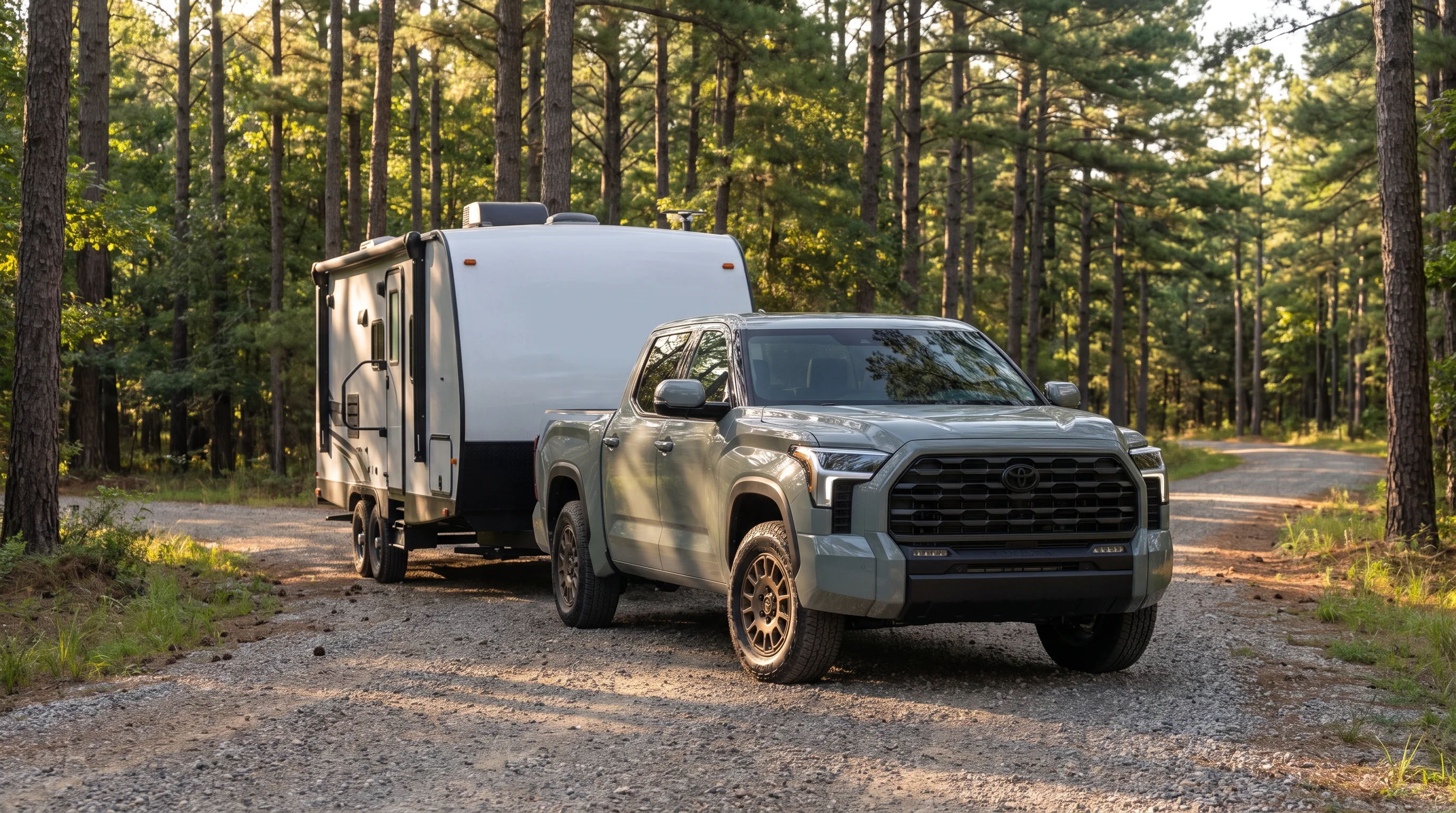
Yes. A 12,000-pound trailer sits far beyond what a standard weight-carrying ball mount can handle. Reaching a tow vehicle’s published maximum at that weight takes a weight-distributing system. Toyota’s guidance is direct: never tow beyond a vehicle’s published towing capacities. Your Owner’s Manual sets the gross trailer weight above which a weight-distributing hitch is required for your vehicle.
Here is why the weight matters. When a trailer couples to a ball, it presses down on the hitch with what is called tongue weight. A standard weight-carrying ball mount transfers 100 percent of that force onto the rear of the tow vehicle, behind the rear axle.
On a 12,000-pound trailer that force runs well into four figures, and it acts on a long lever. The result is rear suspension sag, headlights aimed up into oncoming traffic, an unweighted front axle, vague steering, and longer stopping distances.
Buyers setting up a heavy trailer for the first time often ask our team whether a weight-distribution hitch is actually mandatory before hitting the road. In most states it is not a traffic law. It is a manufacturer requirement and a condition of your hitch’s rating. Factory receiver labels state separate weight-carrying and weight-distributing capacities. Go past the weight-carrying figure and you stress the frame in a way the rating never covered. Need help matching your truck’s receiver rating to your trailer? Visit our showroom at 39660 Lyndon B Johnson Fwy, Dallas, TX 75237, or give our team a call.
How Does a Weight-Distribution Hitch Work?
A weight-distribution hitch uses spring bars under tension as a lever. It moves tongue weight off the rear axle, sending part of it forward to the steering axle and part of it back onto the trailer’s own axles. That levels the tow vehicle, puts the front tires back in contact for steering and braking, and takes out the rear-end sag.
Think of a wheelbarrow. Lifting the handles uses leverage to split the load between you and the wheel out front. A weight-distribution hitch applies the same principle across a truck and trailer.
The Three Parts of the System
Every weight-distribution hitch uses the same three parts. First, a hitch head on an adjustable shank. Second, two high-strength spring bars, in either round-bar or trunnion style. Third, L-brackets or chain brackets mounted to the trailer’s A-frame.
When the coupler drops onto the ball, tongue weight forces the rear of the truck down. Tensioning the spring bars against the frame brackets creates steady upward force on the hitch head. That leverage pushes the truck’s front frame back down. It loads the front tires and sends a share of the weight back onto the trailer’s tandem axles.
Why It Matters at the Top of a Tow Rating
Proper load distribution matters on every body-on-frame tow vehicle, and it matters most as you approach a published maximum. The 2026 Toyota Tundra towing capacity reaches up to 12,000 pounds when properly equipped. Its i-FORCE 3.4L Twin-Turbo V6 is rated at 389 horsepower and 479 lb-ft of torque.
Smaller Toyotas carry their own ceilings. The 4Runner is rated for up to 6,000 pounds when properly equipped. The practical rule holds whatever you drive. As a trailer nears what your vehicle is rated to pull, weight distribution stops being optional. It becomes part of how the rating was earned.
Maximum towing and payload capacity figures are based on properly equipped vehicles and vary by configuration. Do not exceed any weight rating. See your owner’s manual and the vehicle’s door-jamb label for specific capacities.
Can a Weight-Distribution Hitch Increase Towing Capacity?
No. A weight-distribution hitch cannot raise a tow vehicle’s maximum manufacturer-rated towing capacity or its Gross Combined Weight Rating. What it does is let the receiver and vehicle reach their full weight-distributing rating instead of being held to the lower weight-carrying limit.
Every tow vehicle has hard physical limits. They come from chassis engineering, axle capacities, brake sizing, cooling capacity, tire load index, and frame stiffness. Maximum towing capacity is the ceiling the maker set under SAE J2807 testing. That standard defines how a trailer weight rating is figured from Gross Combined Weight Rating.
Bolting a 14,000-pound-rated aftermarket system onto a vehicle rated for 6,000 pounds does not make it a 14,000-pound tow vehicle. The whole setup is limited by its lowest-rated part. That could be the frame, the cooling system, the receiver, the shank, the ball, or the trailer axle.
The Two Ratings on Your Receiver Label
What the system actually changes is the receiver’s operating limit. Factory receivers carry two distinct ratings on a safety label beneath the rear bumper:
| Weight-Carrying (WC) | Weight-Distributing (WD) | |
|---|---|---|
| What it covers | Maximum trailer weight and tongue weight using a standard ball mount, no spring bars | Maximum trailer weight and tongue weight with an active weight-distribution system installed |
| When it applies | Light trailers below the manufacturer’s weight-distribution threshold | Heavy trailers at or above that threshold |
| Where to find it | Left-hand column of the receiver rating label | Right-hand column of the same label |
Before hooking up a 12,000-pound trailer, read the receiver tag. Confirm the weight-distributing row shows at least 12,000 pounds Gross Trailer Weight, and a tongue weight figure that covers your actual loaded tongue load.
How Do You Measure Trailer Tongue Weight at Home?
Measuring tongue weight at home takes a purpose-built tongue weight scale, a commercial platform scale, or a heavy-duty bathroom scale rigged with a 3:1 lever.
What Percentage Should Tongue Weight Be?
The percentage is where most setups go wrong. Industry guidance puts tongue weight at 10 to 15 percent of loaded trailer weight, and SAE J2807 requires a minimum of 10 percent. On a 12,000-pound trailer that is at least 1,200 pounds on the ball, and as much as 1,800 pounds at the top of that range.
That upper figure is exactly where heavy setups get into trouble, and it is the part most towing articles skip. A tow vehicle publishes its own maximum tongue weight, separate from its trailer rating. On a half-ton truck, that ceiling often sits below 15 percent of a maximum-rated trailer.
Tongue weight also counts against payload. It draws on the same budget as your passengers, your fuel, and anything in the bed. Before you commit to a 12,000-pound trailer, check two numbers: the tongue weight figure on your receiver’s rating label, and the payload figure on the driver’s door-jamb sticker. At the top of a tow rating, the margin is thin.
Too little tongue weight is its own hazard. Below 10 percent the trailer goes tail-heavy and can start a violent high-speed sway. Too much overloads the rear axle and pushes past Gross Axle Weight Rating.
Maximum towing and payload capacity figures are based on properly equipped vehicles and vary by configuration. Do not exceed any weight rating. See your owner’s manual and the vehicle’s door-jamb label for specific capacities.
Three Ways to Measure Tongue Weight
| Method | How it works | What to watch |
|---|---|---|
| Tongue weight scale | Purpose-built hydraulic or mechanical scale sits under the coupler or jack | Most direct reading, no math — but check the scale’s rated capacity against your expected tongue load |
| Commercial platform scale | Weigh the truck alone, then truck and trailer combined, then the trailer axles separately; subtract to isolate tongue weight | Most accurate, but requires a trip to a truck scale with the rig fully loaded |
| Bathroom scale and lever | Standard bathroom scales top out around 300 to 400 pounds, so a lever divides the load: pivot at one end, scale three feet away, coupler support one foot from the pivot — multiply the reading by three | Requires a sturdy beam and careful measurement; a 3:1 ratio means small errors triple |
Always measure with the trailer loaded the way you will actually travel, including fresh water, propane, batteries, and cargo inside. If tongue weight falls outside the target window, shift cargo forward or rearward over the trailer axles to bring it back.
Does Sway Control Come Built Into Weight-Distribution Hitches?
Many modern weight-distribution hitches build sway control into the head and bracket hardware. Entry-level systems use a separate add-on friction bar instead. Built-in designs rely on friction sockets, spring-bar tension brackets, or dual-cam assemblies. All of them fight the side-to-side motion caused by crosswinds, road ruts, and passing semi-trucks.
Sway happens when a side force pushes the trailer sideways and the motion feeds back into the tow vehicle. Older systems used round spring bars on chains and snap-up brackets. They leveled the vehicle well but did little against sway. Drivers added a telescoping friction bar between the hitch head and a ball on the trailer tongue. It had to be tightened by hand. It also had to come off before backing into tight spots, or it would bind.
2-Point Integrated Sway Control
Rigid L-brackets on the trailer frame replace hanging chains. Spring bars rest directly on friction brackets, resisting side-to-side movement while distributing weight.
4-Point Integrated Sway Control
Adds rotational friction sockets inside the hitch head, on top of the rigid frame brackets. That creates friction at four contact points and holds the trailer in line, with no extra bars or electronics.
One note for boat owners. Rigid-bracket sway systems can restrict the fore-and-aft sliding motion a surge brake actuator needs to compress. For surge brakes, choose a surge-compatible weight-distribution hitch, or a chain-style setup that lets the actuator travel.
Mechanical sway control also works alongside what the vehicle already does. The 2026 Toyota Tundra comes standard with Trailer-Sway Control. It uses the stability system to help keep the trailer in line. It backs up a properly adjusted hitch. It does not replace one.
Can You Install and Adjust a Weight-Distribution Hitch Yourself?
Yes, with standard hand tools, a torque wrench, and a tape measure on level ground. Budget one to two hours. You will measure the front and rear wheel well heights twice: before and after tensioning the spring bars.
- Measure stock height. Park the unloaded tow vehicle on flat, level concrete. Measure from the ground to the top of the front and rear wheel well arches. Record these uncoupled baselines.
- Level the trailer and set ball height. Use a level on the trailer frame and adjust the tongue jack until it sits horizontal. Measure from the ground to the top inside of the coupler. Set the hitch head on the shank to match that height, adjusting head tilt with the manufacturer’s washers or spacers.
- Mount the frame brackets. Attach the L-brackets or chain brackets to the trailer A-frame at the distance specified in your hitch manufacturer’s instructions.
- Couple and engage the bars. Back up, drop the coupler on the ball, and latch it. Use the tongue jack to raise the truck’s rear end and trailer tongue together several inches. This relieves tension and makes it easy to seat the spring bars in the head sockets and swing them onto the brackets.
- Lower and re-measure. Retract the jack so full weight rests on the hitch, then measure both wheel wells again. The front should return to within about a half inch of its uncoupled baseline. If it is still high, add spring bar tension or head tilt; if it sits lower than stock, back the tension off. The rear should compress evenly without bottoming the bump stops.
- Torque to spec. Torque the shank bolts and hitch ball nut to the figures in your hitch manufacturer’s instructions. Do not guess, because these are load-bearing fasteners.
Fine-tuning bracket height and head angle is what separates a rig that tracks straight at highway speed from one that wanders.
The information in this article is general guidance and does not constitute a specific diagnostic or repair recommendation for any individual vehicle. Repair and maintenance decisions should be made in consultation with a certified technician based on the specific condition of your vehicle.
Common Questions About Weight-Distribution Hitches
What happens if you tow 12,000 pounds without a weight-distribution hitch?
The rear axle takes the entire tongue load, the rear end sags, and the front end lifts. That reduces steering control, cuts front braking traction, and aims your headlights up into oncoming traffic. Bumper-pulling 12,000 pounds on a standard weight-carrying ball mount also exceeds the receiver’s weight-carrying limit, which invites severe trailer sway and risks damage to the receiver and frame.
How do you read a hitch receiver rating sticker?
The label sits on the hitch frame tubing near the receiver opening at the rear bumper. It lists two columns, Weight-Carrying and Weight-Distributing, and each gives a maximum Gross Trailer Weight and a maximum Tongue Weight. To tow 12,000 pounds, the Weight-Distributing row must show at least 12,000 pounds of trailer weight, with a tongue weight figure that covers your measured load.
Do weight-distribution hitches work with surge brakes?
They do, but only if you pick a model built for surge actuators. Standard rigid-bracket 4-point sway systems can lock the trailer tongue and stop the hydraulic actuator from compressing when you brake. A surge-compatible weight-distribution hitch or a chain-style setup preserves the linear travel the actuator needs.
How do you know when the spring bars have enough tension?
Compare the front wheel well height to the baseline you measured before coupling. After hooking up and tensioning the bars, the front fender should sit within roughly a half inch of that uncoupled measurement. If the front end is still riding high, add tension or tilt the hitch head down.
Which Toyota can tow a 12,000-pound trailer?
Among Toyota’s lineup, the Tundra is the one rated to 12,000 pounds, and only in specific configurations with the gas i-FORCE V6, properly equipped. Ratings vary by cab, bed, and drivetrain across the rest of the lineup, and the i-FORCE and i-FORCE MAX powertrains carry different numbers. Check the specific configuration before matching a truck to a 12,000-pound trailer.
Maximum towing and payload capacity figures are based on properly equipped vehicles and vary by configuration. Do not exceed any weight rating. See your owner’s manual and the vehicle’s door-jamb label for specific capacities.
Disclaimers
Maximum towing and payload capacity figures are based on properly equipped vehicles and vary by configuration. Do not exceed any weight rating. See your owner’s manual and the vehicle’s door-jamb label for specific capacities.
The information in this article is general guidance and does not constitute a specific diagnostic or repair recommendation for any individual vehicle. Repair and maintenance decisions should be made in consultation with a certified technician based on the specific condition of your vehicle.
0 comment(s) so far on Is a Weight-Distribution Hitch Required to Tow 12,000 Pounds?