Open Today Sales: 8:30 AM-8 PMOpen Today Service: 7 AM-6 PMOpen Today Collision Center: 7:30 AM-6 PM
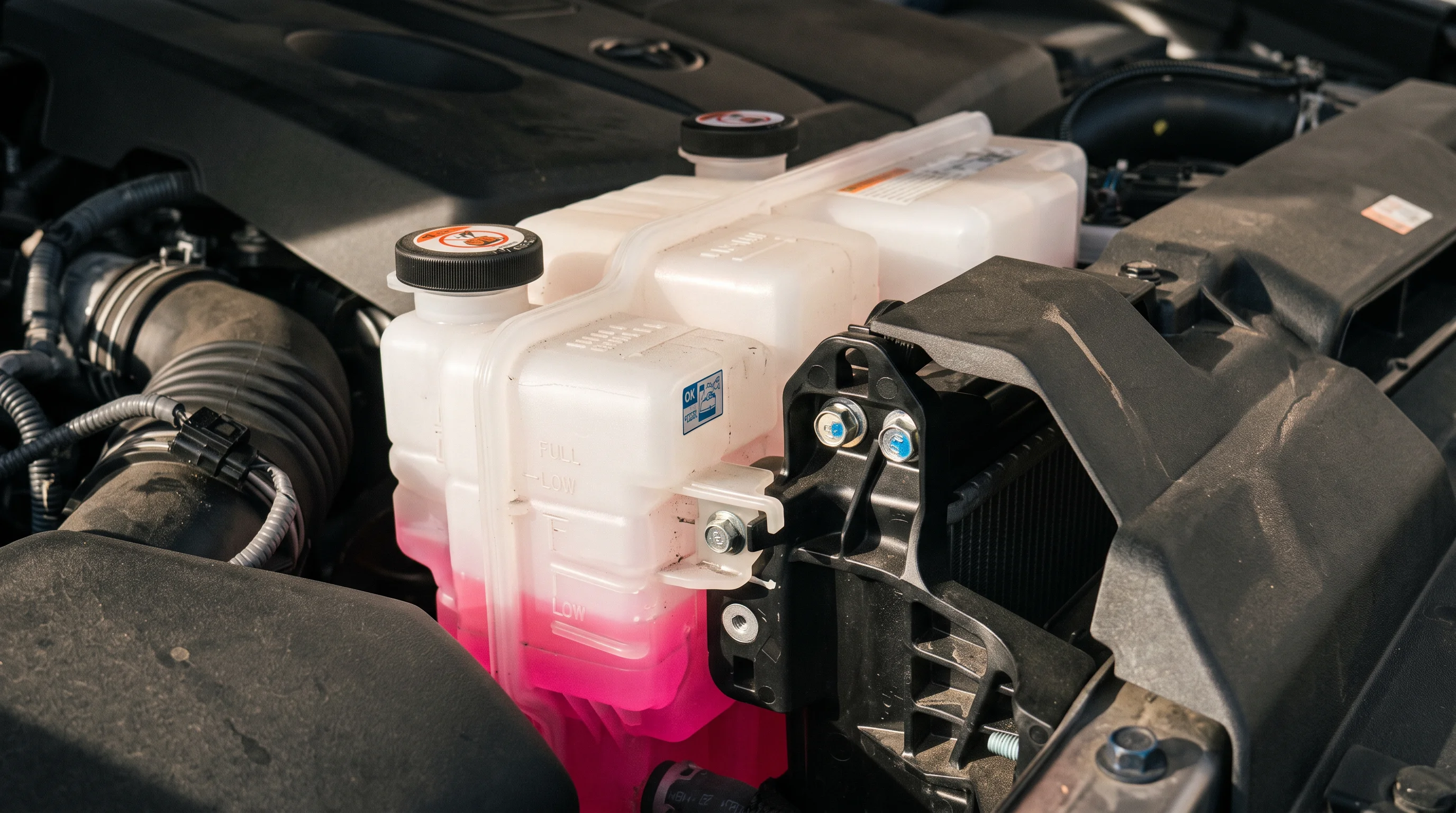
Coolant is what keeps your Tundra’s engine from cooking itself. It is also one of the few fluids where using the wrong product causes damage rather than just shortening a service interval.
Whether you drive a 2008 Tundra with the 5.7L V8 or a current truck with the 3.4L i-FORCE twin-turbo V6, Toyota specifies the same family of coolant. This guide covers what that coolant is, how to tell when it needs changing, and how the drain-and-fill is done. If you would rather hand it off, our service team in Dallas handles coolant service for Tundra owners across South Dallas, Duncanville, and DeSoto.
The Toyota Tundra uses Toyota Super Long Life Coolant (SLLC). It is a pink, pre-diluted, ethylene glycol coolant built on phosphated hybrid organic acid technology. It contains no silicates, no borates, and no amines, and it ships from the factory already mixed 50/50 with deionized water.
That specification has stayed consistent across Tundra generations. Second-generation trucks with the 4.6L and 5.7L V8s take it. So do third-generation trucks with the i-FORCE twin-turbo V6 and the i-FORCE MAX hybrid. What changes between generations is how much the system holds and how many circuits it has, not which coolant goes in.
Toyota’s published interval for SLLC is 100,000 miles or 10 years for the first change, then every 50,000 miles or 5 years after that. Intervals differ by model year and market. Confirm the figure in your Toyota owner’s manual.
You can use a certified equivalent, but it has to match the chemistry. An equivalent means silicate-free, phosphated hybrid organic acid technology. It does not mean any coolant that happens to be pink.
Toyota SLLC is pink. That is the color you should see in the reservoir on any Tundra from 2007 forward, and the color you should be buying.
Toyota’s older Long Life Coolant (LLC) is red, and the two are not interchangeable on equal terms:
| Super Long Life Coolant (SLLC) | Long Life Coolant (LLC) | |
|---|---|---|
| Color | Pink | Red |
| Supplied as | Pre-diluted 50/50, ready to pour | Concentrate, must be diluted before use |
| Typical application | Tundra model year 2007 and newer | Older Toyota vehicles predating SLLC |
| First replacement | 100,000 miles or 10 years | Shorter than SLLC — confirm in your owner’s manual |
| Subsequent replacement | 50,000 miles or 5 years | Shorter than SLLC — confirm in your owner’s manual |
| If the two are mixed | Pink SLLC is backward compatible with red LLC, but mixing forfeits the extended interval and the system reverts to the shorter LLC schedule | |
If the fluid in your reservoir is any color other than clear pink — brown, cloudy, or rust-tinged — that is a condition problem rather than a specification problem. See the symptom list below.
No. Universal green antifreeze uses inorganic additive technology built around silicates, and the Tundra’s cooling system is designed for silicate-free phosphated chemistry.
Silicates work by laying a fast-acting protective film across metal surfaces. That suited older cast-iron engines well. In a modern system it creates two problems. First, they are mildly abrasive against the high-speed mechanical seal faces in the water pump. Second, their protection falls off as the fluid ages. That leaves dropout deposits behind, and those deposits restrict the narrow passages in aluminum radiators and heater cores.
Topping off pink SLLC with green antifreeze also disturbs the additive balance of the mix. That can cause additive fallout and reduced heat transfer where you least want it. If green coolant has already gone into your expansion tank, that is one of the few situations where a full flush is genuinely warranted rather than a drain-and-fill.
Yes. Valvoline’s ZEREX Asian Vehicle antifreeze/coolant is formulated for vehicles that require silicate-free, phosphated hybrid organic acid chemistry, which is what the Tundra calls for.
This is the part that trips people up at the parts counter. ZEREX Asian Vehicle comes in several dye colors. Each one is matched to a different group of manufacturers. The variant Valvoline formulates for Toyota, Lexus, and Scion is the red one — even though Toyota’s own factory fluid is pink. Match the bottle to the vehicle brand, not to the color already in your reservoir.
Toyota does not approve any aftermarket coolant brand by name, so treat this as a compatible equivalent rather than a factory-endorsed product.
| Specification | Toyota Super Long Life Coolant | ZEREX Asian Vehicle (red) |
|---|---|---|
| Base fluid | Ethylene glycol | Ethylene glycol |
| Technology | Phosphated hybrid organic acid | Phosphated hybrid organic acid |
| Silicates | None | None |
| Borates | None | None |
| Amines and nitrites | None | None |
| 2-EHA | Not used | None |
| Supplied as | Pre-diluted 50/50 only | Pre-diluted 50/50 or concentrate — check the label |
| Replacement timing | 100,000 mi / 10 yr initial, then 50,000 mi / 5 yr | Valvoline refers owners to the vehicle’s own manual; its 5 yr / 150,000 mi figure is a freeze-up and boil-over guarantee, not a drain interval |
Buy the pre-diluted version. ZEREX Asian Vehicle is sold both pre-mixed and as a concentrate, and the bottles look similar on the shelf. Pouring concentrate into the system undiluted will not protect the engine the way it should and will need to be corrected. Toyota SLLC has no such ambiguity — it is only sold pre-mixed, and you should not add water to it.
More than most owners expect, because the Tundra does not run a single cooling loop.
Current trucks with the i-FORCE twin-turbo V6 carry a main engine circuit plus a separate charge-air cooling circuit serving the turbocharging system. Trucks with the i-FORCE MAX hybrid powertrain add a third, independent circuit for the power control unit and electric motor electronics. That is why those models have a second, smaller reservoir under the hood. Older V8 Tundras are simpler, with no charge-air loop at all.
This matters for two reasons. First, a radiator drain only empties part of the system. A significant volume stays trapped in the block, heater core, and connecting lines, so a single drain-and-fill never replaces everything. Second, the total varies by generation, powertrain, and equipment. A published range is not useful for deciding what to buy.
Get the exact capacity for your truck from the capacity table in your owner’s manual, or call our parts department with your VIN. We will tell you how much you need and which part number to order.
For the 2027 Tundra, Toyota has confirmed the gas twin-turbo V6 and the available i-FORCE MAX hybrid carry over, but complete model-year specifications have not yet been published. Fluid capacities for that model year will come from the owner’s manual at release.
Coolant degrades on a schedule, but it also degrades early when something else is wrong. Watch for:
None of these are cosmetic. Overheating damage on a modern turbocharged engine is expensive, and it tends to escalate quickly once it starts.
The information in this article is general guidance and does not constitute a specific diagnostic or repair recommendation for any individual vehicle. Repair and maintenance decisions should be made in consultation with a certified technician based on the specific condition of your vehicle.
For routine maintenance, a drain-and-refill is the right call. A full chemical flush is a repair procedure, not a maintenance one.
| Drain and refill | Full chemical flush | |
|---|---|---|
| What it does | Empties the radiator and replaces roughly half the total volume | Pushes flushing solution and water through block, radiator, and heater core under pressure |
| When to use it | Routine service at the scheduled interval | Green silicate coolant was added; fluid has turned dark brown or black from neglect; oil or combustion gases entered the cooling passages |
| Effect on the system | Fresh 50/50 pink coolant blends cleanly with the clean residual fluid left in the block | Strips deposits throughout, including ones that were doing no harm |
| Risk to consider | Does not replace all the fluid in one pass | On a high-mileage truck, cleaners can strip mineral deposits that were quietly sealing pinholes in an aging radiator or hose fitting |
For a truck in normal condition, consecutive drain-and-refills get you clean fluid without that exposure.
The information in this article is general guidance and does not constitute a specific diagnostic or repair recommendation for any individual vehicle. Repair and maintenance decisions should be made in consultation with a certified technician based on the specific condition of your vehicle.
The job has four parts. Let the engine cool completely. Drain the radiator. Refill with pre-diluted 50/50 pink coolant. Then run the engine with a spill-proof funnel and the cabin heat on to purge trapped air.
Work on a completely cold engine. Remove the lower engine splash shield to reach the bottom of the radiator, position the catch pan under the petcock drain, and open the drain valve. Removing the radiator or expansion tank cap lets the fluid flow freely.
Close the petcock firmly once dripping stops. Fit the spill-proof funnel to the radiator neck or expansion tank filler with the matching adapter. Pour the pre-diluted coolant in slowly until the level sits partway up the funnel. Filling slowly lets air escape instead of getting trapped in the block.
Start the engine with the funnel attached and partly full. Set the cabin climate control to maximum heat on a low fan speed. Let the engine idle until it reaches operating temperature and the thermostat opens. Raise the engine speed briefly and periodically to move air through the upper radiator hose, and squeeze the upper hose gently, with gloves on, to help bubbles release. Continue until bubbles stop rising into the funnel and the heater blows hot at idle.
Air in the system is the part people get wrong. Trapped pockets create localized hot spots, erratic temperature readings, and poor cabin heat. They also accelerate water pump cavitation over time.
The information in this article is general guidance and does not constitute a specific diagnostic or repair recommendation for any individual vehicle. Repair and maintenance decisions should be made in consultation with a certified technician based on the specific condition of your vehicle.
If you would rather not spend an afternoon under the truck, our service department handles Tundra coolant service, including drain and fill, system pressure testing, and cooling system inspection.
Coolant work is a good moment to check the rest of your Toyota maintenance schedule. Cooling system service tends to land near other interval items. Newer trucks may still have coverage under ToyotaCare for factory-scheduled maintenance.
Call our service advisors at 945-758-1471 to book, or schedule service online. We are at 39660 Lyndon B Johnson Fwy in Dallas, convenient to Duncanville, DeSoto, South Dallas, Arlington, and Waxahachie.
No. Toyota SLLC comes pre-diluted 50/50 with deionized water from the factory, and adding more water thins the inhibitor package and raises the freezing point. Only add water if you are using a concentrate that requires dilution, or in an emergency top-off when pre-mixed coolant is not available.
Trapped air creates steam pockets in the block and cylinder heads, which causes localized overheating, erratic temperature gauge behavior, and reduced cabin heat. Over time it also accelerates water pump cavitation. If the system was recently opened and the heater is blowing cool, bleed it again before driving further.
Trucks with the i-FORCE MAX hybrid powertrain have two reservoirs under the hood. The main one serves the combustion engine, and a second, smaller reservoir serves the power control unit and electric motor electronics. Both take 50/50 pink coolant and both need their levels checked.
Tap water carries dissolved calcium, magnesium, and iron that precipitate out under engine heat and form scale inside radiator tubes and cooling passages. Use distilled or deionized water if you have no pre-mixed coolant on hand, and have the system corrected afterward.
Toyota’s red Long Life Coolant and pink Super Long Life Coolant share compatible anti-corrosion chemistry, so mixing them is not an immediate failure. What it does is cost you the extended service interval, because the mixture reverts to the shorter schedule that applies to red LLC. Check your owner’s manual for that interval.
The information in this article is general guidance and does not constitute a specific diagnostic or repair recommendation for any individual vehicle. Repair and maintenance decisions should be made in consultation with a certified technician based on the specific condition of your vehicle.
Yes. Toyota has issued safety recall campaigns affecting select 2025 Toyota Tacoma trucks for both front driveshaft integrity (NHTSA campaign 25V656) and rear brake hose durability (NHTSA campaign 25V058). Three more campaigns also touch the 2025 Tacoma. Every recall inspection and any replacement work it calls for is performed at no cost to you. Schedule…
Contact Our Team Browse New Tundra Inventory View New Vehicle Specials Yes. A 12,000-pound trailer sits far beyond what a standard weight-carrying ball mount can handle. Reaching a tow vehicle’s published maximum at that weight takes a weight-distributing system. Toyota’s guidance is direct: never tow beyond a vehicle’s published towing capacities. Your Owner’s Manual sets…
Ver Inventario Sienna Contactar a un Asesor Ofertas en Vehículos Nuevos Toyota Sienna 2026 llega a Dallas con sistema híbrido de serie en toda la gama. Ofrece capacidad para siete u ocho pasajeros. Remolca hasta 3,500 libras en cada versión. Los precios van desde $42,915 TSRP hasta $60,305 TSRP. La EPA califica las versiones de…